
PDFs guide
How to Unlock a Password Protected PDF e-Aadhaar — Free and Private
e-Aadhaar will not print, crop, or merge until you remove the open password. Here is how CSC and cyber-café desks unlock PDFs locally when they already know the code — no upload, no cracking, no desktop install.
By Pixelandpdf · Published · Updated · 10 min read
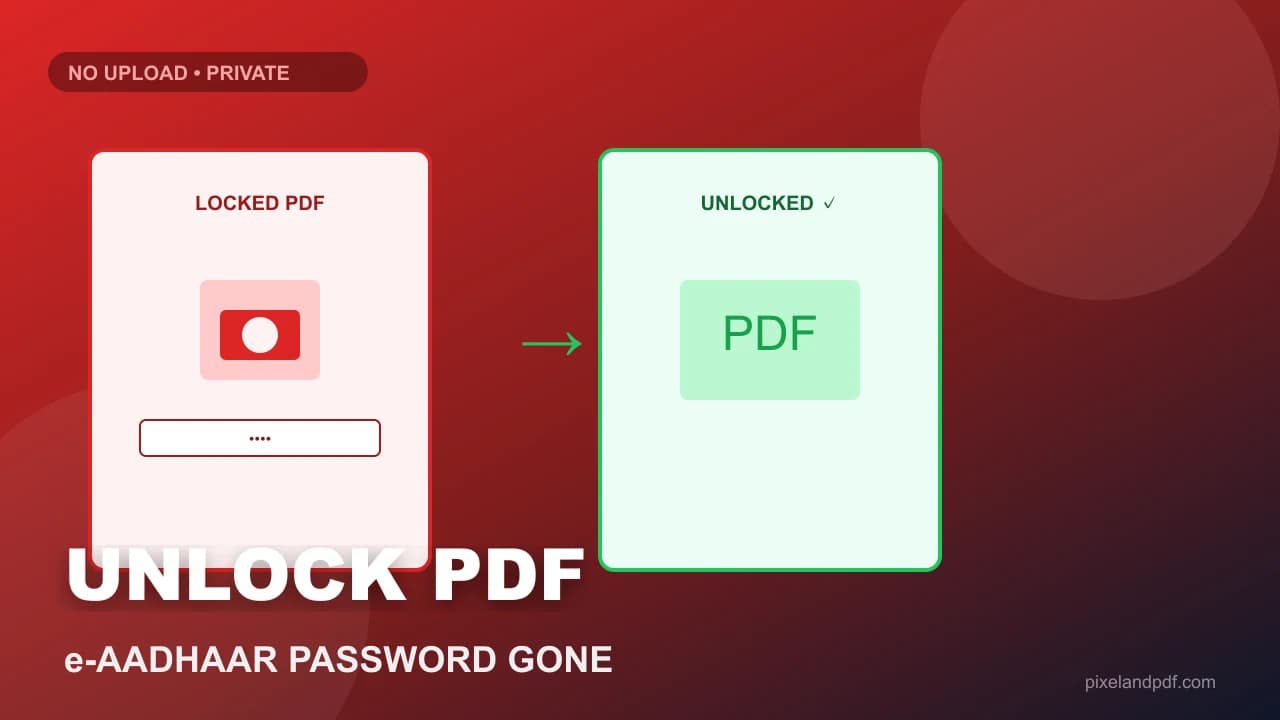
The most common stall at an Aadhaar print counter is not a broken printer — it is a PDF that refuses to open. The customer downloaded e-Aadhaar from myAadhaar, copied it to a USB stick, and now Adobe Reader, Chrome, and the crop tool all demand a password before showing the card face. Until you unlock password protected PDF e-Aadhaar files, nothing downstream works: no PVC layout, no merge with PAN, no compress-to-200KB for a portal upload.
UIDAI sets the password at download time — usually the first four letters of the name in capitals plus the birth year. That is not a secret hack; it is the documented format. Unlocking means you type the password you already have and save an unprotected copy for print. It does not mean guessing someone else's file, brute-forcing a lost password, or uploading the document to a shady online PDF password remover that keeps a plaintext copy on its servers.
This guide explains the legitimate CSC and cyber-café workflow: when unlock is the right step, why client-side decrypt beats upload sites for ID PDFs, how e-Aadhaar passwords are formatted, caps on file size and page count, and what to do after download so the unlocked file does not sit in a shared Downloads folder overnight. Everything here uses a browser unlocker on PixelAndPDF that never sends your file to us.
Quick steps
- Confirm you have the correct password — for e-Aadhaar, usually NAME in CAPS + YYYY birth year (e.g. SURE1990).
- Open the Unlock PDF tool and drop the protected file onto the page — it stays on your device (max about 40 MB, 60 pages).
- Enter the user password when prompted; this tool does not guess or crack unknown passwords.
- Wait for on-device decrypt to finish, then download the unprotected PDF.
- Proceed to print or compress, and delete both locked and unlocked copies from shared PCs when the job is done.
Unlock PDF means you already know the password — not crack it
Search results for unlock pdf and pdf password remover blur two very different jobs. The first is decrypting a file when you have the legitimate open password — e-Aadhaar after myAadhaar download, e-PAN, bank statements, passworded form packs. The second is attacking a file you are not authorised to open. PixelAndPDF only supports the first. If you do not know the password, we will not brute-force it or sell recovery services.
Government downloads encrypt with fragments the citizen chose or that the portal documents clearly. Cyber-café staff hear it won't open dozens of times daily; typing the password once and saving an open copy for Aadhaar card print is faster than installing desktop unlock utilities that phone home or uploading e-Aadhaar to random unlock password protected PDF e-Aadhaar websites.
Honest caps keep shared PCs stable: roughly forty megabytes and sixty pages per file in the browser. Beyond that, memory spikes on CSC Chromebooks. Split long reports, or unlock on a laptop with more RAM, then transfer only the pages you need.
- Legitimate unlock requires the known password — no cracking.
- e-Aadhaar, e-PAN, and DigiLocker exports are typical desk jobs.
- Upload-based unlock sites store plaintext after decrypt — avoid for IDs.
- Unlock before merge or compress — encrypted inputs often block those tools.
Why client-side unlock matters for e-Aadhaar and ID PDFs
Password protected does not mean safe to upload. The moment an e-Aadhaar hits an online pdf password remover, you have trusted that operator with the full document after decrypt — name, address, photo, Aadhaar number. Running unlock in the browser keeps plaintext on the same device that already had the password typed into it, ideally the CSC PC the customer is standing beside.
After download, treat the unlocked file as more sensitive than the locked one, because it opens on any double-click without a prompt. Prefer unlocking immediately before print, then deleting both copies from Downloads when the customer leaves. WhatsApping e-Aadhaar to yourself for later is how identity PDFs end up on personal phones and cloud backups.
Owner passwords that restrict editing or printing are a different PDF feature from open passwords. If a file opens but the print button is greyed out, the issue may be permission flags in the reader. Clearing the open password is still step one; if print remains blocked, try the browser print dialog or re-save from a modern reader after unlock.
e-Aadhaar password format and the mistakes that cause unlock failure
UIDAI's standard e-Aadhaar password is the first four letters of the name exactly as on the Aadhaar card, in capital letters, followed by the four-digit year of birth — NAME+YYYY. Example: Suresh born 1990 → SURE1990. Using a nickname, lowercase letters, or DDMMYYYY instead of YYYY are the top three counter failures when the customer insists the password is correct.
Caps Lock, extra spaces pasted from SMS, and wrong file (masked Aadhaar versus full e-Aadhaar) cause the rest. Ask the customer to re-download from myAadhaar on Wi-Fi if the PDF might be truncated — corrupted downloads fail unlock even with the right password because the encryption envelope is incomplete.
DigiLocker sometimes wraps the same e-Aadhaar with identical password rules but a different download path. If unlock fails, verify the name spelling against the physical card, not against WhatsApp display names. For non-Aadhaar passworded PDFs (bank KYC, salary slips), the password is whatever the issuer set — the unlock tool still only accepts what you type, it does not infer.
- Standard e-Aadhaar: first 4 name letters (CAPS) + birth year (YYYY).
- Re-download if the file size looks too small or pages are blank.
- Check name spelling against the physical card, not phone contacts.
- Masked Aadhaar and full e-Aadhaar are different products — confirm which file you have.
Fastest method: unlock password protected PDF in your browser (no upload)
For a single e-Aadhaar blocking a PVC queue, a browser unlocker is the shortest route. Open the page, drop the PDF, type the password, download the open copy. No install, no licence, no account. The Unlock PDF tool on PixelAndPDF decrypts locally — nothing is sent to our servers — then you can chain directly to card print or compress tools in new tabs.
Compare that to free unlock pdf online sites that upload your file, process on their hardware, and email you about premium plans afterwards. For payslips and contracts that is a poor trade; for e-Aadhaar it is unacceptable under basic desk hygiene. Read the privacy statement: if it does not say local processing, assume upload.
Whichever tool you use, verify the output before deleting the locked original. Open the unlocked PDF, scroll to the photo and address block, and confirm nothing truncated. Keep the original until the portal accepts an upload or the PVC print succeeds — then delete both from shared storage.
- Drop file → enter known password → download unlocked PDF.
- Chain to Aadhaar print, PAN print, or compress after unlock.
- Verify photo and text legibility before deleting the locked source.
- Prefer HTTPS pages you opened yourself over ad pop-up unlockers.
Fitting unlock into the CSC print-shop pipeline
Typical Aadhaar desk flow: unlock → crop layout → PVC. Keeping those as separate URLs means each page explains its own caps instead of one cluttered dashboard. Staff learn three short bookmarks better than a mega-app with twelve toggles hidden behind a hamburger menu.
Order of operations saves repeat visits. Unlock first if the file will not open. Merge after unlock when combining e-Aadhaar with address proof scans. Compress after unlock when a portal demands 200 KB — encrypted inputs usually cannot be merged or shrunk until they are open. Customers who try compress first waste time on error messages that mention password not encryption quality.
If unlock succeeds but Aadhaar card print still shows a blank crop, the PDF may be image-only at wrong resolution, truncated, or not e-Aadhaar at all. Unlocking removes encryption; it does not repair a phone photo saved as PDF.
Troubleshooting: wrong password, size limits, and security after unlock
When unlock fails with the right password, retry with Caps Lock off, re-type manually instead of paste, and re-download from UIDAI. If the customer changed their legal name on Aadhaar but uses an old download, the password may still follow the old card spelling — match the download date to the name epoch.
Files over about 40 MB or 60 pages may exceed browser limits on café hardware. Split with a desktop reader on a better PC, unlock each part, or unlock only the pages needed for the form. Do not assume failure means wrong password — check file size first.
Security after unlock: clear Downloads, empty Recycle Bin on shared PCs, and do not leave unlocked e-Aadhaar in the print queue folder overnight. VLE audits ask where ID data lives; browser-only unlock plus immediate deletion is the defensible answer.
- Failure with correct password: truncation, wrong name epoch, or Caps Lock.
- Huge scans: split or unlock on a machine with more memory.
- Unlocked files open without prompt — treat as highly sensitive.
- No watermark on legitimate unlock output — still delete copies promptly.
Frequently asked questions
Drop the file on a browser unlocker, enter the known password (usually NAME in CAPS + birth year), and download the open PDF. On PixelAndPDF decrypt runs locally — nothing is uploaded.
Usually the first four letters of the name in capital letters plus the four-digit birth year, for example SURE1990 for Suresh born 1990. Match the spelling on the Aadhaar card.
No. You must supply the correct password. We do not offer brute-force or recovery attacks on files you are not authorised to open.
Safer on a client-side tool than on upload-based sites, because unlocked bytes stay on your device. Still delete the file from shared CSC PCs after printing.
Common causes: Caps Lock, wrong birth year format, truncated download, or name spelling that differs from the card. Re-download from myAadhaar on stable Wi-Fi and retry.
About 40 MB and around 60 pages on PixelAndPDF. Larger files need splitting or a desktop reader on a machine with more memory.
Unlock first. Encrypted PDFs usually cannot be compressed or merged until the open password is removed and the content is readable.
Removing the open password lets you read and re-save the file. Most e-Aadhaar print issues are open-password related; if print stays blocked, try the browser print dialog after unlock.
No. The download is an ordinary PDF without PixelAndPDF branding added — but you should still delete copies promptly on shared machines.
Yes in modern mobile browsers within size caps. For large scans, a laptop is more reliable — then transfer only the unlocked file via USB if needed.