
AI guide
Adobe Wants Firefly to Handle the Entire Creative Process: What the AI Shift Means for Creators
Firefly is no longer just an image generator. Adobe is positioning it as the place a creative project begins, develops and finishes — with an AI assistant coordinating Creative Cloud workflows.
By Pixelandpdf · Updated 22 August 2026 · 12 min read
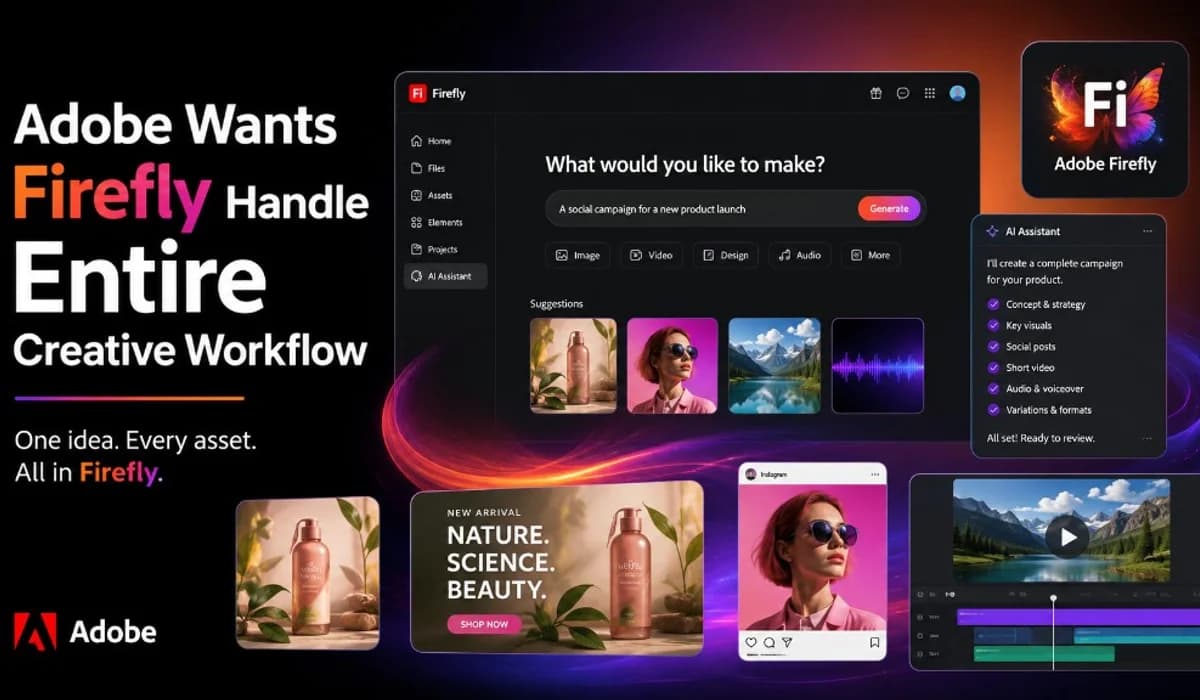
Adobe is no longer treating generative AI as a feature that sits inside Photoshop, Premiere or Illustrator. The company is increasingly positioning Adobe Firefly as the place where an entire creative project begins, develops and gets finished.
That distinction matters.
The latest Firefly developments point toward a bigger change than simply generating an image from a text prompt. Adobe wants users to describe an outcome in ordinary language and have an AI assistant coordinate the tools, models and production steps needed to get there.
In other words, the question is shifting from “What can AI generate?” to “How much of the creative workflow can AI manage?”
Adobe's Firefly AI Assistant, introduced as a public beta in April 2026, is designed to orchestrate multi-step workflows across Creative Cloud applications, including Photoshop, Premiere, Lightroom, Illustrator and other Adobe tools.
That makes the phrase “Adobe Wants Firefly Handle Entire” more significant than a conventional product update. The company is effectively trying to turn Firefly into an AI-powered control layer for creative work.
Quick steps
- Think in outcomes, not apps: describe the audience, style, brand, format and platform you need.
- Use Firefly as the starting point so AI can coordinate Creative Cloud steps instead of hopping between tools manually.
- Keep commercial and brand constraints clear — colors, consistency, licensing and what must stay human-reviewed.
- Let AI handle repetitive production; retain control over typography, pacing, storytelling and final judgment.
- Learn creative direction in natural language: define the result, recognize quality and refine what matters.
Adobe Firefly Is Moving Beyond Image Generation
When Firefly first became widely associated with generative AI, the basic proposition was easy to understand: write a prompt and generate an image.
That market has changed dramatically.
Today, Adobe describes Firefly as an all-in-one creative AI studio capable of working with image, video, audio and other creative tasks. Its current platform brings together more than 30 AI models, including Adobe's own models and models from other AI companies.
The important development is therefore not another image generator.
It is workflow orchestration.
Instead of asking a creator to understand which Adobe application should be used at every stage, Firefly's AI Assistant is intended to understand the desired result and coordinate the necessary actions.
A user could describe a campaign, for example, and ask Firefly to turn a product photograph into social media assets, create variations, develop a visual concept and prepare content for different formats.
The AI handles the process while the human remains responsible for the creative direction.
That is a fundamentally different model from traditional creative software.
From Learning Tools to Describing Outcomes
For decades, professional creative software rewarded people who learned complicated interfaces.
Photoshop has layers, masks, adjustment tools and hundreds of commands. Premiere has timelines, effects, transitions and audio controls. Illustrator has paths, vectors, brushes and countless design functions.
Professional expertise still matters.
But Adobe's new direction suggests that users may increasingly interact with these capabilities through intent rather than interface knowledge.
Adobe says Firefly AI Assistant can select appropriate Creative Cloud tools and execute multi-step workflows based on a user's description.
That could dramatically reduce the time required to perform repetitive production work.
Imagine a small business owner saying: Create a product campaign using this photograph, keep our brand colors, make three social formats and prepare a short promotional video.
Traditionally, that could involve several applications, templates, resizing operations, editing steps and manual revisions.
The emerging Firefly model is to turn that into one conversational workflow.
The creative professional becomes less of a software operator and more of a creative director working with an AI production assistant.
Why This Is More Important Than Another AI Model
The generative AI industry has become crowded.
There are powerful image generators, video generators, writing assistants and design applications competing for users. Model quality continues to improve, but model quality alone is becoming a weaker differentiator.
Adobe has something different: an enormous ecosystem of professional creative software.
That gives Firefly a potential advantage.
A standalone AI generator can produce an impressive image. Adobe can potentially connect generation with editing, asset management, layout, video production, collaboration and final delivery.
Adobe's June 2026 announcements reinforced that direction. The company introduced additional Firefly agentic capabilities while previewing a redesigned creative AI studio designed to connect ideation, creation and production.
The strategic opportunity is obvious: own the workflow, not merely the generation step.
Firefly's Biggest Opportunity May Be Small Businesses
Much of the conversation around AI creativity focuses on professional designers, filmmakers and advertising agencies.
But there is another group that could benefit enormously: small businesses.
A local restaurant may need photographs, menus, promotional graphics, Instagram posts and short videos.
A neighborhood retailer may need product images, advertisements and seasonal campaigns.
A startup may need branding, presentation graphics, website imagery and promotional videos without having a large creative department.
For these businesses, Adobe's AI strategy could be particularly important because the bottleneck is often not creativity. It is production capacity.
One person may be responsible for marketing, social media, design and communications.
A workflow that turns a single brief into multiple finished assets could therefore have a much bigger practical impact than another incremental improvement in image realism.
This is where the Adobe Firefly AI Assistant strategy becomes more interesting.
It potentially gives smaller teams access to a production workflow that previously required multiple people and specialized software skills.
The New Competition Is About Context
There is another important change happening beneath the surface.
AI systems are becoming increasingly capable of maintaining context.
Adobe's upgraded Firefly studio introduces concepts such as Elements and Projects, designed to preserve creative assets and context so users can continue working without rebuilding everything from scratch.
That may sound like a small interface improvement, but it could become one of the most important parts of AI-assisted creativity.
Consider a video series.
A creator needs the same characters, locations, visual style, branding and recurring elements across multiple episodes.
If every AI generation starts from zero, maintaining consistency becomes difficult.
A system that remembers the project's creative context can potentially reduce that problem.
The result is less like asking an AI to generate isolated pictures and more like working with a persistent digital production environment.
Adobe Is Also Building Around Multiple AI Models
Another unusual part of Adobe's strategy is that Firefly is not necessarily about forcing creators to use a single underlying model.
Adobe has increasingly incorporated models from different AI providers into Firefly. Its platform currently promotes access to multiple leading models alongside Adobe's own commercially focused Firefly models.
This is strategically important.
AI models evolve quickly. A model that leads in image generation today may be overtaken by another tomorrow.
If Firefly becomes the interface through which users access multiple models, Adobe can potentially make the model itself less important to the customer.
The user simply asks for the result.
Firefly decides which tools or models are appropriate.
That is closer to an AI operating layer for creative production than a conventional generative AI application.
What Creators Should Watch Closely
Adobe's ambition also raises several questions.
How much control will professionals retain? Professional creators are unlikely to surrender control over every decision. A designer may want AI to create variations but still manually adjust typography. A filmmaker may want an AI-generated rough cut but personally control pacing, sound and storytelling. Adobe appears to recognize this distinction. Its messaging emphasizes that creators remain in control, with the ability to guide, refine or redirect AI-generated work. The winning workflow may therefore not be “AI does everything.” It may be AI handles everything that the creator doesn't need to personally handle.
Will AI-generated work remain commercially usable? For businesses, commercial safety matters just as much as visual quality. Adobe has emphasized commercially focused Firefly models and has positioned them as part of its broader enterprise AI strategy. For agencies and brands, that could become a major differentiator as companies become increasingly cautious about copyright, licensing and content provenance.
Will AI make creative software easier or simply more complicated? There is a paradox here. Adobe is trying to simplify creative work by hiding complexity behind conversational AI. But adding dozens of models, agents, workflows and automated features can also create a new layer of complexity. The best version of Firefly will need to make sophisticated technology feel simpler rather than giving users another dashboard to learn.
The Human Creative Role Is Changing, Not Disappearing
One of the easiest conclusions to make about agentic AI is that it will replace designers, editors or marketers.
The more interesting possibility is that it changes what those professionals spend their time doing.
Instead of manually resizing 20 images, a creative professional can focus on deciding which version works.
Instead of assembling every variation of a campaign, they can concentrate on the campaign's concept.
Instead of spending hours organizing production steps, they can review and improve the output.
That represents a shift from execution toward direction.
The value of creative expertise could increasingly lie in knowing what should be made, what should be rejected and how the final work should feel.
AI can generate options.
Human judgment still determines which options matter.
Adobe's Real Goal: Make Firefly the Creative Starting Point
This may ultimately be the most important takeaway from the latest Adobe Firefly developments.
Adobe is not merely adding AI to Creative Cloud.
It appears to be trying to reverse the traditional relationship between its applications and the creative process.
Previously, a creator might think: Idea → Photoshop → Illustrator → Premiere → Adobe Stock → final output.
The emerging Firefly model is closer to: Idea → Firefly → AI coordinates the workflow → Adobe tools execute and refine → final output.
That is a major strategic shift.
Adobe wants the user to begin with the outcome rather than the application.
Its June 2026 announcement explicitly described the goal as connecting the stages of creative work from ideation through production, while its AI Assistant is designed to coordinate multi-step work across Creative Cloud.
What This Means for the Average Creator
You do not need to become an AI engineer to take advantage of this shift.
The more useful skill is learning how to describe creative objectives clearly.
Instead of thinking only in terms of individual commands, creators can increasingly think in terms of the desired audience, visual style, brand identity, final format, intended platform, desired emotional response, elements that must remain consistent and parts that require human refinement.
This is essentially creative direction expressed in natural language.
And that could become one of the most valuable AI-era skills.
The Bigger AI Story Is No Longer Generation
The first wave of generative AI taught consumers that machines could create things.
The next wave is teaching them that machines can participate in workflows.
Adobe's Firefly strategy is an early example of the second phase.
The company is attempting to connect generation, editing, organization and production through an AI agent that understands the user's goal rather than simply responding to isolated prompts.
That could make Firefly considerably more important than another AI image generator.
For creators, the practical question is not whether AI will produce a better picture tomorrow.
It is whether AI can remove enough production friction that creators can spend more time thinking, directing and improving.
Final Takeaway
The headline behind Adobe Wants Firefly Handle Entire is really about a change in the role of creative software.
Firefly is moving toward becoming the front door to Adobe's creative ecosystem: a place where users can describe an idea, assemble assets, generate content, edit it, adapt it and move toward a finished project without constantly thinking about which application should handle each step.
Adobe has already made significant moves in that direction with Firefly AI Assistant, multi-model access, persistent project concepts and agentic workflows.
For creators, the takeaway is simple: don't focus only on learning how to generate with AI. Learn how to direct AI.
The creators who benefit most from the next phase of Firefly may not be the people who produce the most prompts. They may be the people who can clearly define the outcome, recognize quality and use AI to eliminate the work that gets in the way of creating it.
Frequently asked questions
Adobe is positioning Firefly as where a project begins, develops and finishes — with an AI assistant coordinating Creative Cloud tools — not only generating a single image from a prompt.
A public beta introduced in April 2026 that orchestrates multi-step workflows across Creative Cloud apps such as Photoshop, Premiere, Lightroom and Illustrator based on a user’s description of the outcome.
Standalone generators produce assets. Firefly aims to connect generation with editing, asset management, layout, video, collaboration and delivery inside Adobe’s ecosystem — workflow orchestration, not only generation.
Their bottleneck is often production capacity, not ideas. One conversational brief that yields multiple formats can replace hopping between apps for photos, posts and short videos.
Concepts in the upgraded Firefly studio meant to preserve creative assets and context so campaigns and series stay consistent instead of restarting from a blank prompt each time.
No. Adobe promotes multiple leading models alongside its own commercially focused Firefly models, so the interface can choose tools or models for the result.
Adobe’s messaging emphasizes that creators stay in control and can guide, refine or redirect AI work. The likely model is AI handling what creators do not need to do personally.
Agencies and brands care about copyright, licensing and provenance as much as quality. Adobe has emphasized commercially focused Firefly models for enterprise use.
Creative direction in natural language: audience, style, brand, format, platform, emotion, consistency and what still needs human refinement — directing AI, not only prompting it.
Firefly is becoming the front door to Creative Cloud. Focus less on generating more prompts and more on defining outcomes, recognizing quality and using AI to remove production friction.