
AI guide
Gemini 3.7 Flash Is Not Just a Lighter Gemini Model — Here’s What Changed
Google’s August 2026 Flash release targets coding and agents with configurable thinking levels, a 1M-token context window and intro API pricing — not a stripped-down flagship.
By Pixelandpdf · Updated 22 August 2026 · 11 min read
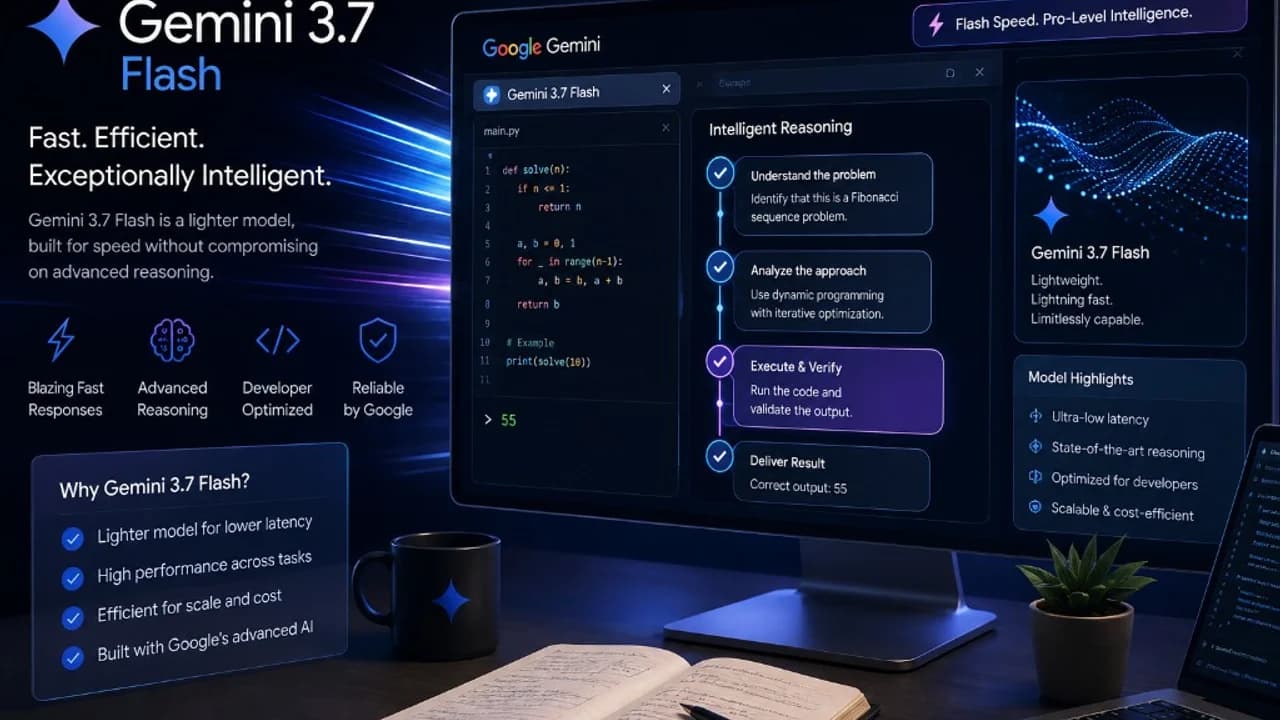
Google's latest Gemini release is easy to misunderstand if you judge it by the word “Flash” alone.
On August 13, 2026, Google introduced Gemini 3.7 Flash, describing it as its most intelligent workhorse model yet for coding and agentic tasks. The release arrived only three weeks after Gemini 3.6 Flash and was accompanied by improvements in software engineering, web development, document reasoning and business automation.
That creates an important distinction for developers and everyday AI users: Gemini 3.7 Flash is not simply a lighter version of a larger Gemini model.
It is better understood as Google's attempt to make a relatively fast and cost-efficient model capable of handling work that previously demanded more expensive, heavyweight reasoning systems.
That matters in both the United States and India, where developers are increasingly building AI agents, coding assistants, document-processing systems and business automation tools where inference cost can become just as important as raw model intelligence.
Quick steps
- Read “Flash” as a cost/latency tier with configurable reasoning — not automatically “less intelligent.”
- Match thinking level (low, medium, high) to task difficulty; higher effort burns more tokens and costs more.
- Use Gemini 3.7 Flash for coding, agents, web dev and document workflows where you need repeated inference at scale.
- Compare intro API pricing ($0.75 / $3.75 per million tokens through Dec 2026) against your call volume before committing.
- Treat Google’s benchmarks as directional; validate on your own prompts, tools and latency requirements.
What Happened
Google announced Gemini 3.7 Flash on August 13, 2026, making the model generally available through the Gemini API and Google AI Studio. It is also available through Google's broader developer and enterprise ecosystem.
The model is based on Gemini 3.6 Flash but introduces algorithmic improvements to its reasoning foundation. Google DeepMind's model card says developers can customize the model's thinking configuration to control the balance among quality, cost and latency.
The introductory API price is $0.75 per million input tokens and $3.75 per million output tokens through December 31, 2026. Google says those prices will increase to $1.50 and $7.50 respectively beginning January 1, 2027.
- A 1-million-token input context window
- Up to 64K output tokens
- Text, image, audio, video and PDF inputs
- Function calling
- Search grounding
- Computer use in preview
- Code execution
- File search
- Structured outputs
- Three thinking levels: low, medium and high
Why This Matters Now
The interesting part of Gemini 3.7 Flash isn't simply that Google released another Gemini model.
The bigger story is where Google is putting intelligence.
Traditional AI model lineups often create a simple hierarchy: smaller and faster models handle routine work, while larger models handle difficult reasoning.
Gemini 3.7 Flash challenges that assumption.
Google is explicitly targeting coding, multi-step agents, web development and knowledge-intensive workflows with the model. Its documentation calls it the company's most capable Flash model and recommends it for complex coding and agentic workflows.
In other words, “Flash” increasingly describes the model's operating position rather than simply meaning “less intelligent.”
That could be particularly important for companies building AI products at scale.
A model that is slightly less capable but dramatically cheaper can be more commercially useful than a flagship model if an application needs to make thousands or millions of calls.
The Important Detail Most Readers May Miss
The most important feature of Gemini 3.7 Flash may not be its benchmark scores.
It is the thinking-level control.
Developers can select low, medium or high thinking effort. Google says low thinking is intended for latency-sensitive tasks, while medium is the default and high is designed for difficult reasoning, mathematics, coding and agent tasks. Higher thinking effort can consume more tokens and therefore increase cost.
This creates something closer to an adjustable intelligence dial.
For example, a customer-support application might use lower thinking effort for straightforward requests. A coding agent investigating a difficult production bug could switch to higher reasoning effort.
That flexibility makes the “lighter model” description incomplete.
Gemini 3.7 Flash can be lightweight economically and operationally, while still spending substantially more computation when the task requires it.
That is a different proposition from simply shrinking a flagship model.
Gemini 3.7 Flash vs Gemini 3.6 Flash
Google's own evaluations show significant gains over Gemini 3.6 Flash across several important workloads.
These are Google's published evaluation results, not independent tests conducted for this article, so they should be interpreted accordingly.
Still, the pattern is notable.
The largest improvements aren't concentrated only in simple question answering. They appear in areas involving coding, automation, document understanding and agentic execution.
For example, Google reports Gemini 3.7 Flash scoring 43.6% on FrontierCode 1.1 Main, compared with 34.4% for 3.6 Flash. On DeepSWE v1.1, the newer model reaches 65.3%, versus 48.6% for its predecessor.
That is exactly the category of improvement that matters when an AI model is expected to do work rather than simply generate text.
- FrontierCode 1.1 Main — Gemini 3.7 Flash: 43.6% | Gemini 3.6 Flash: 34.4%
- DeepSWE v1.1 — Gemini 3.7 Flash: 65.3% | Gemini 3.6 Flash: 48.6%
- Code Arena WebDev — Gemini 3.7 Flash: 1588 Elo | Gemini 3.6 Flash: 1538 Elo
- Terminal-Bench 2.1 — Gemini 3.7 Flash: 85.8% | Gemini 3.6 Flash: 78.0%
- AutomationBench — Gemini 3.7 Flash: 30.4% | Gemini 3.6 Flash: 17.0%
- GDP.pdf — Gemini 3.7 Flash: 34.0% | Gemini 3.6 Flash: 22.0%
- OSWorld-2.0 — Gemini 3.7 Flash: 47.9% | Gemini 3.6 Flash: 33.8%
- HLE-Verified — Gemini 3.7 Flash: 53.6% | Gemini 3.6 Flash: 51.2%
The Price-Performance Story Is the Real Competition
The competitive argument becomes more interesting when price is included.
Google's published comparison lists Gemini 3.7 Flash at $0.75 per million input tokens and $3.75 per million output tokens during its introductory period.
The same table lists Claude Sonnet 5 at $2 per million input tokens and $10 per million output tokens, while GPT-5.6 Terra is listed at $2 input and $12 output. These figures come from Google's own comparison and should not be treated as an independent pricing study.
The strategic implication is nevertheless clear.
Google isn't necessarily trying to win every benchmark with Gemini 3.7 Flash.
It is trying to make high-quality reasoning affordable enough to run repeatedly inside real applications.
For a developer building an autonomous coding agent, research assistant or enterprise workflow, the difference between a few dollars and several dollars per million tokens becomes significant at scale.
India could be an especially interesting market for this approach because startups, software teams and AI developers often have to balance sophisticated model capabilities against tightly controlled infrastructure and API budgets.
The same calculation applies in the United States, particularly for SaaS companies whose AI inference bill grows alongside customer usage.
What This Means for Users
For ordinary Gemini users, the release is less about token prices and more about what the underlying model can accomplish.
Google says Gemini 3.7 Flash is being used in Gemini Spark, its personal AI agent, for Google AI Pro and Ultra subscribers in supported countries. Google says the update improves tool use and complex multi-skill workflows, including consolidating files, drafting emails and updating status documents.
For developers, the consequences are more direct.
A coding assistant can use the model for debugging and issue resolution. A web-development agent can generate interfaces from references. A business application can process complex documents. An enterprise agent can combine reasoning with tools and execute multi-step workflows.
The 1-million-token context window is also significant for workloads involving large documents, codebases or long-running sessions.
But context capacity should not be confused with guaranteed perfect understanding. A large context window gives a system room to process more information; it does not automatically mean every detail will be interpreted correctly.
The Limitations
There are several reasons not to interpret Google's benchmarks as proof that Gemini 3.7 Flash is simply “better than everything.”
First, many of the published numbers come from Google's own evaluation presentation. Different benchmark implementations, prompts, tool configurations and evaluation procedures can produce different outcomes.
Second, Gemini 3.7 Flash does not lead every listed benchmark.
For example, Google's table shows GPT-5.6 Terra ahead on DeepSWE v1.1, Terminal-Bench 2.1 and OSWorld-2.0. Claude Sonnet 5 also leads Gemini 3.7 Flash on some knowledge-work and biological research evaluations.
Third, higher thinking effort can increase token consumption and cost. Therefore, the headline introductory price does not mean every difficult task will cost exactly the same amount as a low-effort request. Google's documentation explicitly notes higher token consumption with higher thinking levels.
And finally, “Flash” should not be interpreted as meaning that Gemini 3.7 Flash is universally faster, cheaper or more capable for every workload.
The appropriate model depends on the task.
What Happens Next
The bigger question is whether Google's Flash strategy changes how developers choose AI models.
If models like Gemini 3.7 Flash can deliver strong coding and agent performance while keeping inference costs comparatively low, developers may have less reason to reserve advanced reasoning for only the most expensive model tiers.
That could push the market toward dynamic model selection, where applications automatically choose how much reasoning to spend based on task difficulty.
Simple tasks could use low thinking effort.
Moderately difficult work could use medium.
Hard problems could trigger high reasoning or even be routed to another model.
That would make the distinction between “small model” and “large model” increasingly less useful for consumers.
The more meaningful question becomes: How much intelligence does this particular task need, and how much are you willing to pay for it?
Gemini 3.7 Flash is an important step in Google's attempt to make that trade-off configurable.
Conclusion
The most interesting thing about Gemini 3.7 Flash is that Google is moving away from the idea that a “Flash” model has to be a basic or heavily compromised alternative.
The August 13 release combines a relatively low introductory API price with configurable reasoning, a 1-million-token context window and stronger results on several coding and agent benchmarks.
So if the original assumption is that Google Gemini 3.7 Flash is supposed to be a lighter model, the better interpretation is more nuanced.
It is designed to be lighter on cost and latency, while becoming considerably heavier in what Google expects it to accomplish.
That distinction could prove more important than the “Flash” name itself. If developers can reliably get advanced reasoning and agent behavior without paying flagship-model prices for every request, Google's Flash strategy could become one of its most important weapons in the increasingly competitive AI model market.
Frequently asked questions
Not in the simplistic sense. “Flash” represents Google's faster, scalable model tier, but Gemini 3.7 Flash is specifically designed for complex coding, reasoning and agentic workflows. Google calls it its most intelligent Flash model yet.
Google positions it particularly strongly for software engineering, web development, agentic workflows, knowledge work and multimodal reasoning.
Yes. Developers can configure low, medium or high thinking effort. Medium is the default setting, while high is intended for more difficult reasoning and coding tasks.
The introductory API price through December 31, 2026 is $0.75 per million input tokens and $3.75 per million output tokens. Google says those prices will increase on January 1, 2027.
Yes. The model supports up to 1,048,576 input tokens and up to 65,536 output tokens according to Google's API documentation.
Google announced Gemini 3.7 Flash on August 13, 2026, making it generally available through the Gemini API, Google AI Studio and Google's broader developer and enterprise ecosystem.
Developers can set low, medium or high thinking effort to balance quality, cost and latency. Low suits latency-sensitive tasks; medium is default; high targets difficult reasoning, maths, coding and agent work — and can use more tokens.
During its introductory period Google lists Gemini 3.7 Flash at $0.75 input and $3.75 output per million tokens versus Claude Sonnet 5 at $2 input and $10 output — figures from Google's own comparison, not an independent study.
Text, image, audio, video and PDF inputs, plus function calling, search grounding, computer use (preview), code execution, file search and structured outputs.
Google says Gemini 3.7 Flash powers Gemini Spark for Google AI Pro and Ultra subscribers in supported countries, improving tool use and multi-skill workflows such as consolidating files and drafting emails.