
AI guide
Grok 4.6 Challenges the Frontier AI Market With Long-Running Agents
xAI’s August 2026 release focuses on multi-step agents — 500K context, configurable reasoning, $2/$6 API pricing and rapid Bedrock and Model Garden distribution.
By Pixelandpdf · Updated 22 August 2026 · 12 min read
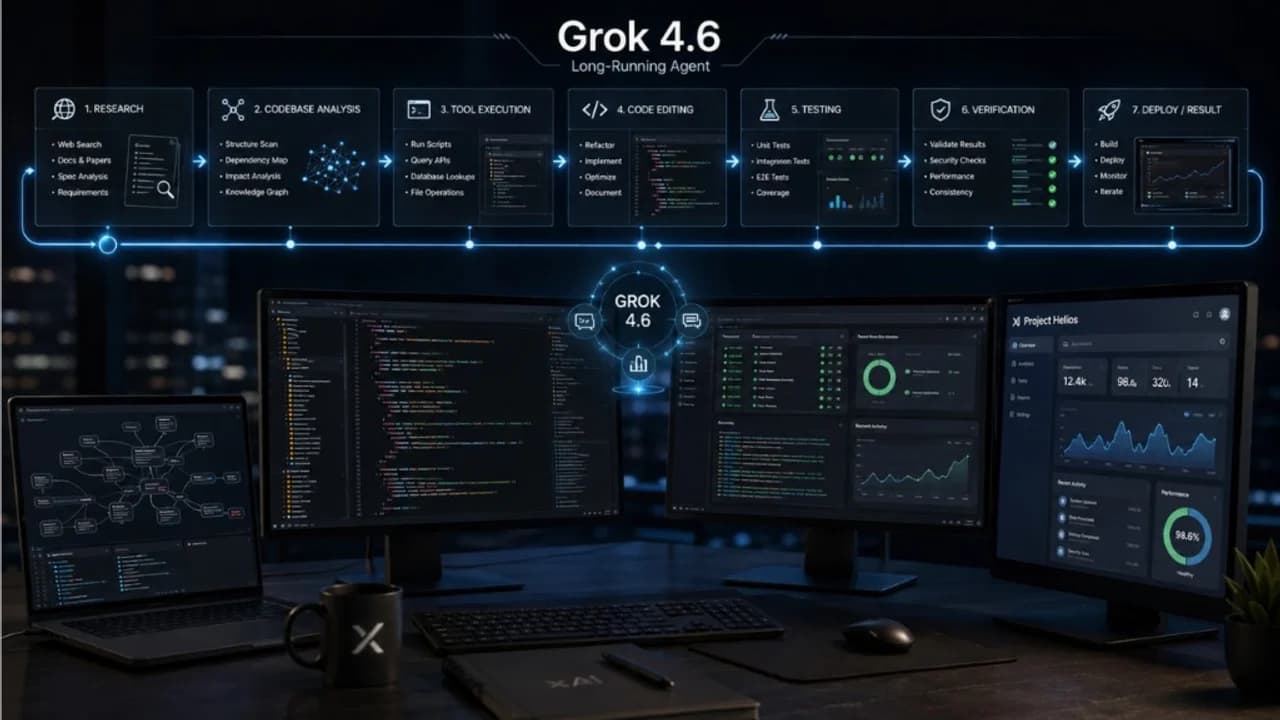
xAI released Grok 4.6 on August 12, 2026, positioning it less as a routine model upgrade and more as a system designed for a different kind of AI workload: long-running agents that can research, code, analyze information, use tools and keep working through multiple stages of a project. The model builds on Grok 4.5 while adding a stronger emphasis on extended agent trajectories and ambitious interactive and visual work.
The interesting part is not simply that xAI says Grok 4.6 has “frontier intelligence.” The more consequential change is the combination of agent-focused capabilities, a 500,000-token context window, configurable reasoning effort and relatively aggressive API pricing. That combination could make Grok 4.6 particularly relevant to developers building agents rather than people simply looking for a faster chatbot.
There is an important caveat, however: most of the headline capability numbers are benchmark results rather than independent evidence that Grok 4.6 will outperform every competing model on real-world workloads.
Quick steps
- Treat Grok 4.6 as an agent model — evaluate multi-step trajectories, not single-turn chat quality.
- Use the 500K context for large codebases and document sets, but still design verification and retry logic.
- Compare $2 input / $6 output per million tokens against your agent’s token volume and reasoning effort.
- Check deployment paths: xAI API, Cursor, Grok Build, Amazon Bedrock and Google Cloud Model Garden.
- Validate on your own workloads — vendor benchmarks do not guarantee reliability on your repo or tools.
What Happened
xAI announced Grok 4.6 on August 12, describing it as a successor to Grok 4.5 with a particular focus on long-running agents and more ambitious interactive and visual work. xAI says the model is intended to remain engaged with difficult tasks across many steps, including research, analysis, software engineering and creating working applications or other professional artifacts.
The model is available through the xAI API, while launch partners include Cursor and Grok Build. xAI's current API documentation lists a 500K-token context window and pricing of $2 per million input tokens and $6 per million output tokens. A faster variant costs twice as much.
Availability has also expanded quickly. Amazon Web Services announced on August 19, 2026 that Grok 4.6 was available through Amazon Bedrock, while Google Cloud's release notes show Grok 4.6 entering Model Garden preview on August 21, 2026.
That rapid distribution matters because enterprise adoption often depends as much on deployment options as on benchmark scores.
Why This Matters Now
The AI competition is increasingly moving away from the question, “Which chatbot gives the best answer?” toward a harder question:
Which model can complete a complicated job with the fewest human interventions?
An agent might need to inspect documentation, understand an unfamiliar codebase, modify several files, run tests, diagnose failures, revise its approach and finally produce a working result. The quality of the individual answer matters, but so does the model's ability to maintain a coherent strategy over a long sequence of actions.
That is exactly where xAI is trying to position Grok 4.6.
Cursor's documentation describes the model as being designed for difficult long-running tasks involving creative tool use, including software engineering, data science, finance, legal work and other computer-based workflows. It also says Grok 4.6 is designed to work across large codebases and extended engineering projects.
The distinction is subtle but important. A model that is excellent at answering a single programming question is not automatically excellent at operating as an autonomous engineering agent for an hour.
The Important Detail Most Readers May Miss
The biggest change with Grok 4.6 is not the context window.
The context window remains at 500,000 tokens, the same size listed for Grok 4.5. Instead, the more meaningful shift is how xAI says the model behaves during longer trajectories. xAI says Grok 4.6 performs more self-testing and verification on extended tasks, allowing it to check its work before continuing.
That matters because long-running agents have a compounding-error problem.
If an agent makes a small mistake in step three and continues for another 30 steps, the original error can contaminate everything that follows. A model capable of periodically checking its assumptions, testing intermediate results and changing direction has a better chance of recovering.
This is also why benchmark scores should not be interpreted as a direct measurement of autonomous reliability. Long-horizon performance depends on the complete agent system: the model, tools, execution environment, memory, retry logic, permissions and evaluation method.
Grok 4.6 may be substantially better at the model layer, but that does not automatically mean every Grok-powered agent will be reliable.
Grok 4.6 vs the Frontier Models
xAI's launch materials show Grok 4.6 scoring 61 on the Artificial Analysis Intelligence Index, matching GPT-5.6 Sol in the comparison published with the launch. Artificial Analysis independently reports the same 61 score and describes Grok 4.6 as returning to the frontier tier.
Here is the more useful picture:
Benchmark figures are dependent on model version, reasoning configuration and evaluation methodology; competitor pricing and specifications should be checked against their current official documentation before making purchasing decisions.
The more striking number is actually the price.
Artificial Analysis reports that Grok 4.6's headline API pricing is unchanged from Grok 4.5 at $2 per million input tokens and $6 per million output tokens, while describing it as substantially cheaper than some competing frontier models.
For agents, that can be more important than a one-point benchmark advantage.
An autonomous workflow may generate thousands or millions of tokens across repeated reasoning, tool calls, corrections and summaries. A model that delivers near-frontier capability at a lower token price can potentially make larger agent workloads economically practical.
- Artificial Analysis Intelligence Index — Grok 4.6: 61 | GPT-5.6 Sol: 61 | Claude Fable 5: 62
- Context window — Grok 4.6: 500K
- xAI API input price — Grok 4.6: $2/M tokens
- xAI API output price — Grok 4.6: $6/M tokens
- Primary Grok 4.6 focus — Long-running agents
What the Benchmarks Actually Show
xAI reports strong results across several agentic coding and knowledge-work evaluations.
Its published results include 69.9% on CursorBench 3.2, 65.9% on DeepSWE v1.1, 61.3% on FrontierCode v1.1 Extended, 57.5% on APEX-Agents and 56.4% on APEX-SWE. xAI also reports a 1,753 Elo score on GDPVal-AA v2.
But these numbers require context.
For example, on the same table, xAI reports Grok 4.6 below the cited GPT-5.6 Sol result on DeepSWE v1.1 and Terminal-Bench v3.0. That means the launch should not be reduced to “Grok 4.6 beats every competitor.” It doesn't.
Instead, the evidence suggests a model that is competitive across a broad range of agentic and knowledge-work tests, with particularly interesting economics for developers.
Artificial Analysis similarly found a 61 Intelligence Index score and highlighted agentic performance, including a 1,753 GDPval-AA v2 Elo.
That distinction makes the story more credible: Grok 4.6 is a frontier contender, but not an across-the-board benchmark champion.
What This Means for Users
For developers in the United States and India, the practical significance may be greater than the headline benchmark ranking.
A developer building an AI coding agent could use Grok 4.6 for tasks such as:
The 500K context window also gives the model room to work with large amounts of information in a single session. xAI and Cursor specifically position it for large codebases and multi-stage knowledge work.
Enterprise developers have another route through Amazon Bedrock. AWS says Grok 4.6 supports configurable reasoning effort levels of low, medium, high and xhigh, alongside enterprise monitoring, logging and regional scaling capabilities offered by Bedrock.
For Indian startups and engineering teams, the pricing is particularly interesting because token economics can influence whether an agent remains a prototype or becomes a production service. That does not mean Grok 4.6 will automatically be the cheapest option for every workload; actual cost depends on token usage, reasoning effort, tool calls and application architecture.
- navigating an unfamiliar repository;
- researching technical documentation;
- editing multiple files;
- running and interpreting tests;
- producing a first version of an application;
- analyzing business documents or spreadsheets;
- performing extended research and synthesis.
The Limitations
The first limitation is that many of the most impressive results come from vendor-published benchmark comparisons or evaluations that depend on specific configurations.
A benchmark score does not establish that Grok 4.6 is better for your particular coding repository, customer-support workflow, research process or enterprise application.
The second limitation is latency.
Artificial Analysis currently lists Grok 4.6 high at about 86 output tokens per second and reports a comparatively high time-to-first-token figure in its measurements.
That is important because a model designed for deep reasoning and long-running work does not necessarily optimize for instant responses.
There is also a fundamental agent problem that no benchmark eliminates: tool reliability. An agent can reason correctly but still fail because a tool returned bad data, a command failed, permissions were insufficient or the model misunderstood the state of an external system.
Finally, Grok 4.6 is proprietary. Its weights are not openly released, so developers depending on the model remain tied to xAI's hosted ecosystem and the availability and pricing of its API and partners. Artificial Analysis lists the model as closed-weight.
What Happens Next
The next important test for Grok 4.6 is not another launch benchmark.
It is real-world agent adoption.
The rapid arrival on Cursor, Grok Build, Amazon Bedrock and Google Cloud suggests xAI wants Grok 4.6 to become infrastructure for developers rather than simply another chatbot model.
The competitive question will therefore shift toward cost per successfully completed task.
If developers discover that Grok 4.6 can reliably finish long software or knowledge-work projects while consuming fewer resources than competing frontier models, its $2/$6 pricing could become a meaningful advantage.
If real-world reliability, latency or tool-use performance proves weaker than benchmark results suggest, the price advantage may matter less.
That is the test the market has not fully answered yet.
Conclusion
Grok 4.6 is important less because it claims another benchmark victory and more because it targets the economics and reliability of long-running AI agents.
Its 500K-token context, configurable reasoning, agent-oriented training and $2/$6 API pricing put it in an interesting position against the frontier-model market. The benchmark evidence shows genuine competitiveness, but it does not prove universal superiority.
The real story will unfold when developers stop asking models isolated questions and start giving them hours-long jobs with tools, codebases and real consequences.
That is where Grok 4.6's “Frontier Intelligence for Long Running Agents” positioning will either become a meaningful competitive advantage—or simply another ambitious model-launch claim.
Frequently asked questions
Grok 4.6 is xAI's frontier AI model released on August 12, 2026. It is designed particularly for long-running agents, coding, knowledge work and ambitious interactive and visual tasks.
xAI says Grok 4.6 focuses more heavily on long-running agent work and ambitious interactive and visual projects. It also received a longer supplemental training run and improvements to its training approach. The context window remains 500K tokens.
xAI's API lists Grok 4.6 at $2 per million input tokens and $6 per million output tokens. A faster variant is priced at twice those rates.
There is no single answer. Grok 4.6 scores 61 on the Artificial Analysis Intelligence Index, matching the cited GPT-5.6 Sol score in xAI's launch comparison, but individual benchmarks show different winners. The right model depends on the workload, latency requirements, tool ecosystem and cost.
Yes. Grok 4.6 is available through xAI's API and has also launched through services including Amazon Bedrock. Google Cloud lists it in Model Garden preview as of August 21, 2026.
500,000 tokens — the same size listed for Grok 4.5. xAI and Cursor position it for large codebases and multi-stage knowledge work in a single session.
Published results include 69.9% on CursorBench 3.2, 65.9% on DeepSWE v1.1, 61.3% on FrontierCode v1.1 Extended, 57.5% on APEX-Agents, 56.4% on APEX-SWE and 1,753 Elo on GDPVal-AA v2 — vendor figures that require workload-specific validation.
Artificial Analysis lists Grok 4.6 high at about 86 output tokens per second with a comparatively high time-to-first-token — a model tuned for deep reasoning may not optimise for instant chat responses.
Launch partners include Cursor and Grok Build. AWS made Grok 4.6 available on Amazon Bedrock on August 19, 2026; Google Cloud added Model Garden preview on August 21, 2026.
61 — matching the cited GPT-5.6 Sol score in xAI's launch comparison. Artificial Analysis independently reports the same score and describes Grok 4.6 as returning to the frontier tier.