
AI guide
Hackers Using AI Target Siemens: Why the Real Risk Is Exposed Industrial Infrastructure
Five U.S. agencies warn that AI-generated exploitation scripts are being used against internet-exposed Siemens S7 PLCs. The deeper story is exposure and misconfiguration — not a brand-new Siemens vulnerability.
By Pixelandpdf · Updated 21 August 2026 · 14 min read
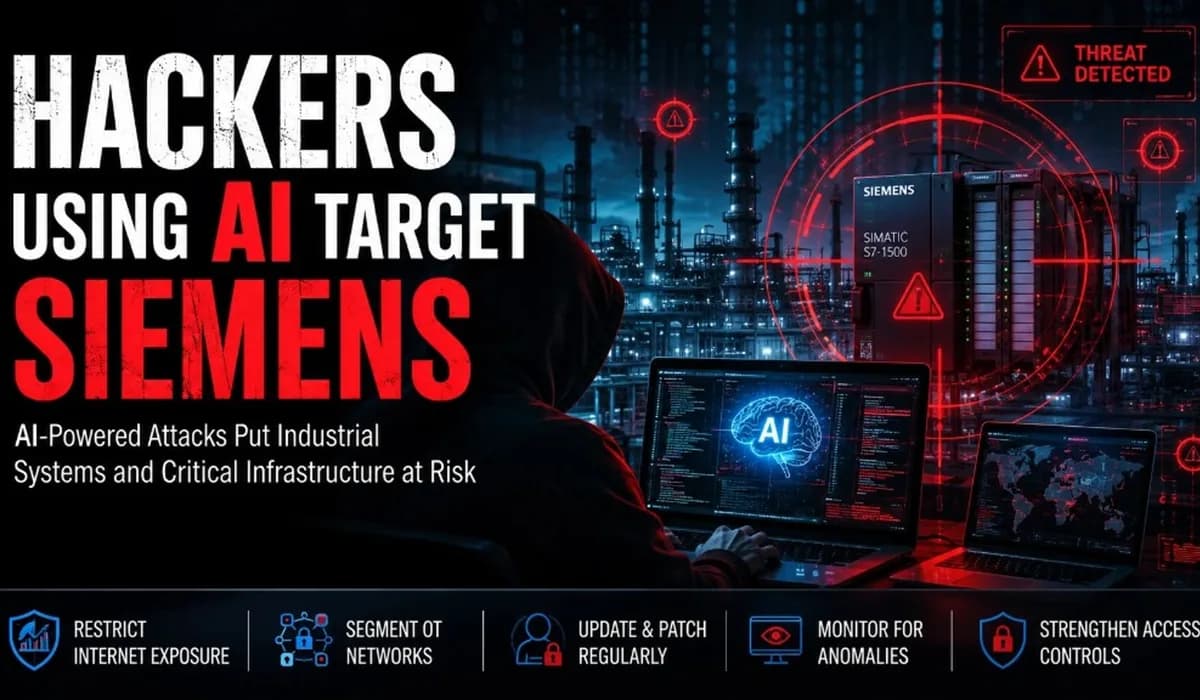
Artificial intelligence is changing cybersecurity in a way that is increasingly difficult to ignore: attackers no longer need to build every tool manually, and industrial systems are now becoming part of that experiment.
The latest warning from U.S. authorities puts Siemens S7 programmable logic controllers (PLCs) at the center of an active cyber threat. Five federal agencies — the NSA, CISA, FBI, Department of Energy and Environmental Protection Agency — warned on August 19, 2026, that threat actors are using AI-generated exploitation scripts while targeting internet-exposed Siemens S7 PLC installations.
But there is an important distinction missing from many headline-driven reports.
This is not primarily a story about a brand-new Siemens vulnerability. Siemens has said it has not identified a previously unknown vulnerability or a general increase in attacks against its industrial-control products. Instead, the warning highlights a more uncomfortable development: attackers are using AI to make existing weaknesses, exposed systems and poor configurations easier to exploit.
That distinction could matter far more than the headline.
Quick steps
- Identify every Siemens S7 PLC — firmware, network location and connections.
- Remove unnecessary internet exposure; remote maintenance should use controlled access, not direct public reachability.
- Segment OT networks so an IT compromise cannot easily move into operational technology.
- Review credentials and access controls — default or weak passwords turn exposure into compromise.
- Update software and firmware; monitor unusual PLC activity; audit third-party remote-access arrangements.
What Is Happening With Siemens S7 PLCs?
PLCs are specialized industrial computers that control physical processes. They can regulate machinery, pumps, motors, production lines and other equipment used in factories and critical infrastructure.
Siemens S7 PLCs are deployed across a wide range of industrial environments, including manufacturing, energy, water and wastewater, chemical facilities, food and agriculture. The U.S. advisory also warns that related equipment can be found in the Defense Industrial Base.
According to the government advisory, attackers are conducting reconnaissance and developing capabilities against U.S.-based Siemens PLC installations. They are using internet-scanning services to locate PLCs that are exposed online, poorly protected or running outdated software.
The particularly new element is the use of AI-generated exploitation scripts, reportedly disguised as legitimate operational-technology monitoring tools.
The agencies describe this as an active threat rather than a hypothetical future scenario.
That is the key development.
Why AI Makes an Old Industrial Security Problem More Dangerous
Industrial cybersecurity has had a fundamental problem for years: many OT systems were designed around reliability and availability rather than today's internet-connected threat environment.
A factory controller may have been installed years ago and configured to communicate with engineering workstations, monitoring systems or remote maintenance services. If that controller eventually becomes reachable from the public internet, an attacker gains an opportunity that may have nothing to do with a sophisticated zero-day exploit.
AI changes the economics of that attack.
Instead of spending significant time manually developing scripts, understanding protocols and adapting code, an attacker can use AI-assisted development to accelerate portions of the process.
That does not mean an AI model independently takes over a factory.
It means the human attacker can potentially move faster.
The U.S. advisory indicates that threat actors are using AI-generated scripts together with publicly available industrial automation libraries. Reports have identified the use of snap7.dll and python-snap7 in tools designed around Siemens S7 communications.
This is an important lesson for defenders: AI does not have to invent a completely new attack technique to have a major impact.
Speed alone can be enough.
The Real Target May Be the Configuration, Not Siemens
One of the most useful takeaways from the latest warning is that organizations should not interpret the story as "Siemens products are suddenly unsafe."
The problem is broader.
The advisory specifically focuses on PLCs that are internet-exposed or insufficiently segmented, including systems with outdated software or weak protection.
That means two identical PLCs can present dramatically different levels of risk.
One may sit behind multiple layers of network segmentation, strict access controls and monitored remote-access infrastructure.
Another could be directly reachable from the internet because an old remote-monitoring configuration was never removed.
The hardware may be identical.
The risk is not.
This is why the current Siemens story should be viewed as an exposure-management problem amplified by AI.
What Makes PLC Attacks Different From Ordinary Data Breaches?
A typical cyberattack against a website might result in stolen credentials, customer information or financial data.
Industrial attacks can cross the boundary from the digital world into the physical world.
A compromised PLC may potentially influence an industrial process. Depending on the environment, that could mean production downtime, altered processes, equipment damage or safety consequences.
The federal advisory lists possible outcomes including disruption of industrial processes, safety incidents, equipment damage and data compromise.
Consider a water-treatment facility.
The PLC is not simply storing a spreadsheet. It may participate in controlling pumps and other physical processes. A cyber incident that affects the controller can therefore become an operational problem.
The same principle applies to manufacturing plants, energy facilities and chemical operations.
That is why industrial cybersecurity cannot be treated exactly like conventional office IT security.
A Critical Detail: This Does Not Mean Every Siemens PLC Has Been Hacked
This distinction is essential for readers trying to understand the severity of the story.
The August 2026 advisory describes active reconnaissance and capability development. It does not establish that every targeted Siemens PLC was successfully compromised or that a widespread destructive attack has already occurred.
Security researchers have emphasized that the activity should be understood as preparation and targeting rather than evidence of a completed catastrophic incident.
That makes the warning arguably more important, not less.
Attackers do not necessarily need to cause disruption during the reconnaissance phase.
They may first identify useful targets, understand the environment and develop the capability needed for a later operation.
For critical infrastructure operators, that creates a window in which defensive action can potentially prevent a much larger incident.
The Siemens Response Adds Another Layer to the Story
Siemens has pushed back against interpretations suggesting that the warning reveals a new fundamental vulnerability in its S7 product family.
The company said the advisory does not describe a new vulnerability in the S7 series and reported that it had not identified either an increased attack level or previously unknown vulnerabilities in its industrial-control products. Siemens characterized the issue as attackers using new methods to exploit potential misconfigurations.
That creates an important contrast.
Government agencies: active threat, AI-assisted attack development and urgent mitigation.
Siemens: no newly discovered vulnerability and no detected increase in attacks against its industrial-control products.
Both statements can be true simultaneously.
A cyberattack can exploit existing weaknesses without requiring a new software flaw.
And AI can make those existing weaknesses more attractive to attackers without turning the underlying product into a newly vulnerable platform.
Why Internet Exposure Is the Biggest Red Flag
Perhaps the least glamorous part of this story is also the most actionable.
If an industrial controller does not need to be reachable from the public internet, it generally should not be.
Security researchers and defenders have repeatedly warned about internet-exposed industrial control systems. The current advisory reinforces that concern by specifically describing attackers using internet-scanning services to find vulnerable or poorly protected PLC installations.
For organizations operating Siemens S7 equipment, the first question should therefore not be:
"Which AI attack are hackers using?"
It should be:
"Can an unauthorized person reach our PLC from the internet?"
That single question can expose a much larger security problem.
What Organizations Should Do Now
Operators of Siemens S7 PLCs should treat the advisory as a reason to review their entire OT environment rather than simply install another security product.
- Identify every PLC — maintain an accurate inventory of S7 controllers, their firmware versions, network locations and connections. Unknown industrial assets are difficult to defend.
- Remove unnecessary internet exposure — public-facing access to PLCs should be eliminated wherever operationally possible. Remote maintenance should go through controlled access mechanisms rather than direct exposure.
- Segment OT networks — industrial control networks should not be treated like ordinary corporate networks. Segmentation can limit the ability of an attacker who compromises an IT system to move toward operational technology.
- Review credentials and access controls — default or weak credentials can turn an exposure problem into a compromise. Review authentication, privileged access, remote-access accounts and third-party connections.
- Update software and firmware — the absence of a new zero-day does not eliminate the importance of patching. Older software can contain known vulnerabilities and weaknesses that become more useful when attackers have AI-assisted development tools.
- Monitor unusual PLC activity — pay particular attention to unexpected communication with PLCs, unusual engineering activity and unauthorized attempts to interact with industrial-control systems. OT monitoring should be integrated into the organization's broader incident-response process.
- Audit third-party remote access — industrial facilities often depend on integrators, equipment vendors and maintenance companies. A controller can become externally reachable because of a remote-support arrangement that was established years earlier. The owner of the PLC may not even realize that the connection remains active.
The Bigger Story: AI Is Lowering the Barrier to Industrial Cyberattacks
The Siemens warning fits into a much broader shift in cybersecurity.
Earlier this year, Google reported that hackers had used AI to help identify and exploit a previously unknown software vulnerability. That incident demonstrated that AI-assisted offensive security is moving beyond simple phishing and automated content generation.
The Siemens case is different because it involves operational technology.
That difference matters.
IT environments can often be rebuilt from backups. Industrial environments may involve physical machinery, safety systems, production schedules and infrastructure that cannot simply be taken offline.
AI therefore creates a troubling combination:
More automation + more exposed industrial devices + faster attacker development = less time for defenders to react.
The technology does not have to become autonomous for that equation to become dangerous.
What This Means Beyond the United States
Although the latest government advisory focuses on U.S.-based Siemens installations, the underlying lesson is global.
Factories, utilities and industrial facilities worldwide use PLC technology and remote-management systems.
That means organizations in Europe, Asia and other industrial markets should not dismiss the warning simply because the advisory was issued by U.S. agencies.
The important question is whether their own industrial systems share the characteristics described in the warning: internet exposure, inadequate segmentation, outdated software, weak access controls or unnecessary remote connectivity.
For countries with rapidly expanding industrial automation and connected manufacturing, that lesson is particularly relevant.
The Bigger Risk Is Not "AI Hacking Siemens"
The most attention-grabbing phrase in this story is "hackers using AI to target Siemens."
But the more useful interpretation is different.
Attackers have discovered another way to accelerate the exploitation of industrial environments that were already difficult to defend.
AI is the accelerator.
Internet exposure is the opportunity.
Weak segmentation and outdated configurations can become the opening.
That distinction changes how organizations should respond.
Buying an "AI-powered cybersecurity" product alone will not solve the problem if a PLC is unnecessarily exposed to the public internet.
Final Takeaway
The Hackers Using Ai Target Siemens story is not simply another warning about artificial intelligence becoming a weapon.
It is a warning about what happens when an old industrial-security weakness meets a new generation of automated offensive tools.
The latest U.S. advisory does not say that Siemens has suddenly discovered a catastrophic new vulnerability. Instead, it shows that attackers are actively exploring Siemens S7 PLC environments and using AI-assisted development to make that process faster and more scalable.
For organizations running industrial infrastructure, the most valuable response is surprisingly straightforward: know what is connected, remove unnecessary internet exposure, segment operational technology, strengthen access controls, patch where appropriate and monitor for abnormal activity.
The AI component deserves attention. But the immediate defensive opportunity is even simpler.
If attackers need AI to help find your industrial systems, don't make those systems easy to find in the first place.
Frequently asked questions
Five U.S. agencies warned on August 19, 2026, that threat actors are using AI-generated exploitation scripts while targeting internet-exposed Siemens S7 PLC installations, including reconnaissance via internet-scanning services.
No. Siemens said it has not identified a previously unknown vulnerability or a general increase in attacks against its industrial-control products. The warning focuses on AI making existing weaknesses, exposure and misconfigurations easier to exploit.
AI can accelerate script development and adaptation around public industrial libraries (reports cite snap7.dll and python-snap7). It does not mean AI independently takes over a factory — it means human attackers can move faster.
A compromised PLC can affect physical processes — production downtime, altered operations, equipment damage or safety incidents — not only stolen credentials or customer data.
No. The August 2026 advisory describes active reconnaissance and capability development, not proof that every targeted PLC was compromised or that a widespread destructive attack has already occurred.
Siemens said the advisory does not describe a new S7 vulnerability and that it had not identified an increased attack level or previously unknown flaws. It framed the issue as attackers using new methods against potential misconfigurations.
Attackers are using scanning services to find PLCs that are online, poorly protected or outdated. If a controller does not need public internet reachability, it generally should not have it.
Inventory every PLC, remove unnecessary internet exposure, segment OT networks, harden credentials, patch firmware, monitor unusual activity and audit third-party remote-access links.
The advisory focuses on U.S. installations, but the lesson is global: any facility with internet-exposed, poorly segmented or outdated PLC environments shares the same risk profile.
AI is the accelerator. Internet exposure is the opportunity. Weak segmentation and outdated configurations are the opening. Fixing exposure matters more than buying an AI security product alone.