
AI guide
How Companies Train Employees on AI: The New Corporate Skills Race
AI usage is racing ahead of AI training. In 2026, companies that teach literacy, role-specific skills, responsible use and continuous practice — plus when not to trust the machine — will pull ahead.
By Pixelandpdf · Updated 22 August 2026 · 13 min read
Artificial intelligence is no longer something companies can leave to the IT department. In 2026, the bigger question is no longer whether employees will use AI, but how companies train employees on AI without creating a workforce that blindly trusts machines.
That distinction is becoming increasingly important as businesses move from experimenting with chatbots to embedding generative AI, automation and AI agents into everyday workflows. Employees are being asked to write with AI, analyze information, build presentations, automate repetitive tasks, support customers and, in some cases, help improve the AI systems themselves.
But there is a problem hiding behind the impressive adoption numbers: AI training is often moving more slowly than AI usage.
The Conference Board's latest research found that organizations are generally preparing workers to use AI in their current jobs, while relatively few are preparing employees for the deeper reskilling that changing jobs may require. Its research included interviews with 35 enterprise leaders and a global survey of nearly 1,300 workers.
That gap could become one of the defining workplace issues of the next few years.
Quick steps
- Teach everyone AI basics: generative AI, hallucinations, prompts, data protection, copyright/privacy and when human review is mandatory.
- Add role-based training so marketing, finance, HR and developers connect AI to work they already perform.
- Use hands-on practice: complete a real task twice — once normally, once with AI — then compare time, accuracy and quality.
- Train restraint: when AI must stay out of promotions, compensation, medical or legal judgment.
- Make learning continuous with workshops, champions, workflow libraries and policy updates — measure outcomes, not course completions.
Why AI Employee Training Is Changing in 2026
Early corporate AI training was often straightforward: introduce employees to ChatGPT, explain prompt engineering and provide a list of rules about confidential information.
That model is quickly becoming outdated.
Today's workplace AI can perform multiple steps, interact with company data, summarize documents, generate code, analyze spreadsheets and increasingly operate as an agent inside business processes. Consequently, employees need more than the ability to write a clever prompt.
They need to understand when AI should be used, when it should not be used, how to verify its output and how AI changes the workflow around them.
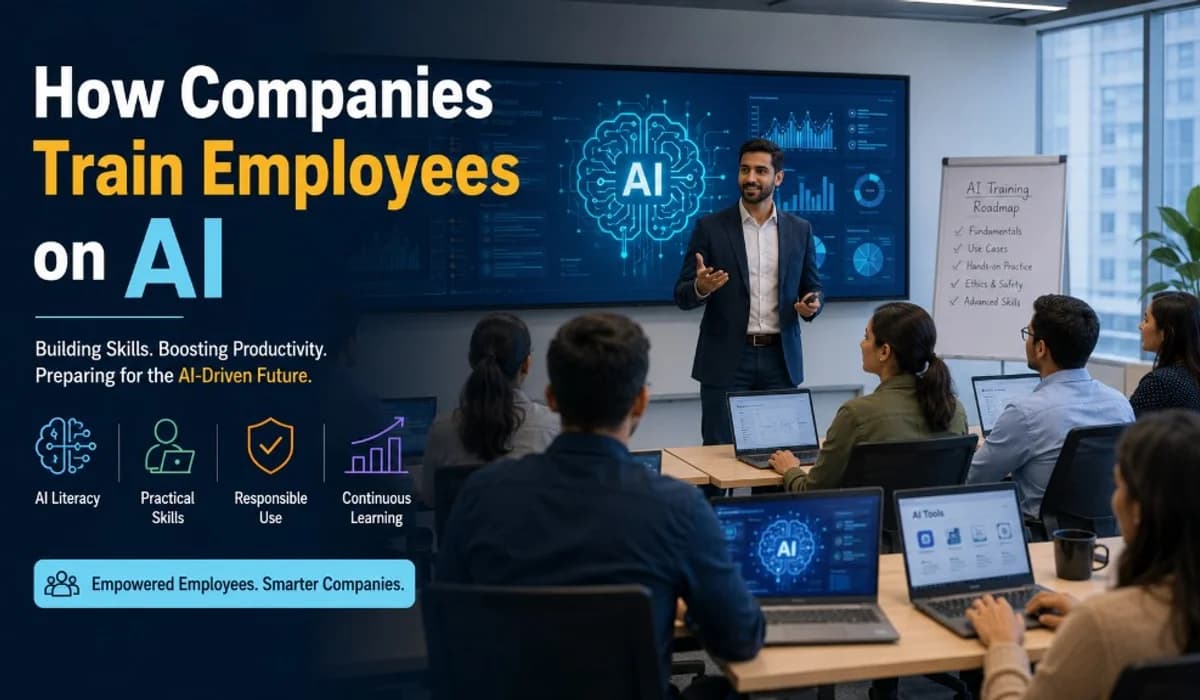
This is why modern AI training increasingly combines four areas.
The shift is significant. Companies are effectively moving from "teaching employees a tool" to teaching employees a new way of working.
- AI literacy
- Practical, role-specific skills
- Responsible and secure AI usage
- Continuous experimentation and reskilling
The First Step: Teach Everyone the AI Basics
The most successful programs usually begin with a common foundation.
Employees don't necessarily need to become machine-learning engineers. A salesperson, accountant, designer or HR professional may never need to understand how a transformer model is mathematically constructed.
But they should understand basic concepts that give everyone a common vocabulary.
It also reduces a major corporate risk: different departments quietly developing completely different assumptions about what AI is allowed to do.
Research from ISACA illustrates why this matters. Its 2025 AI Pulse Poll found that 81% of surveyed digital-trust professionals believed employees in their organizations were using AI, whether officially permitted or not. At the same time, 68% said AI had produced time savings.
In other words, employees may already be using AI before formal training arrives.
That makes training less about introducing AI and more about bringing existing AI behavior under responsible organizational guidance.
- What generative AI does
- Why AI can produce convincing but incorrect information
- What hallucinations are
- How prompts influence outputs
- Why sensitive company information requires protection
- How copyright and privacy considerations affect AI usage
- When human review is mandatory
The Real Breakthrough: Role-Based AI Training
One of the biggest changes in corporate AI education is the move away from one-size-fits-all courses.
A marketing employee doesn't need exactly the same AI education as a software developer.
Instead, companies increasingly map AI capabilities to individual jobs.
Marketing employees might learn how to use AI for content research, campaign ideation, customer segmentation, competitor analysis, first-draft creation, SEO research and performance reporting. But training should also teach marketers how to fact-check AI-generated claims and avoid publishing unsupported information.
Finance professionals may receive training around spreadsheet analysis, report summarization, forecasting assistance, document extraction and financial-data workflows. The emphasis is likely to be stronger on verification because an AI-generated financial error can have much greater consequences than a poorly written social-media caption.
HR teams may use AI for job-description drafting, candidate communications, employee surveys, policy-document analysis and training recommendations. Here, privacy, fairness and bias become central training topics.
Developers can go much deeper, learning how to use AI coding assistants, generate tests, debug applications, review code and automate development workflows. But they also need training in secure coding, dependency risks and verification.
The principle is simple: AI training works best when employees can immediately connect what they learn to work they already perform.
India Is Becoming a Major Testing Ground
The AI training race is particularly interesting in India because of the country's enormous technology and services workforce.
Indian companies are not treating AI education solely as an executive-level initiative. Large employers are increasingly attempting to make AI literacy a workforce-wide capability.
TCS, for example, has pursued large-scale AI upskilling and reported more than 570,000 members of its approximately 600,000-person workforce as AI-ready in material published by LinkedIn. Its approach combines foundational learning with role-specific pathways and hands-on experiences.
EY India has also launched an AI Academy, reporting that it had already upskilled more than 44,000 employees internally in AI and built training around more than 200 real-world AI use cases.
Meanwhile, Salesforce has committed to supporting training for 100,000 learners in India during 2026 through the Yuva AI Bharat: GenAI Skill Catalyst program.
These initiatives reveal something important about India's position in the AI economy.
The competitive advantage may not simply come from having more AI engineers. It may come from having millions of workers who understand how to apply AI to existing business processes.
That is a much broader skills challenge.
Companies Are Moving Toward Hands-On AI Training
Traditional corporate training often means watching videos, completing quizzes and receiving a certificate.
AI training increasingly requires something different: practice.
Employees may be asked to take a real task from their job and complete it twice—once using their existing process and once using AI.
For example: "Create the monthly customer report using your normal workflow. Now redesign the workflow using an AI assistant. Compare the time, accuracy and quality."
This creates a measurable learning experience.
It also forces employees to confront an important reality: AI is not automatically better simply because it is faster.
A workflow that takes 30 minutes instead of two hours is not necessarily successful if the resulting information contains errors that require another hour of checking.
That is why leading AI programs increasingly focus on outcomes rather than course completion.
The Most Valuable Skill May Be Knowing When Not to Use AI
There is an overlooked side of AI training: restraint.
Employees need to learn when AI should stay out of a process.
For instance, an organization may decide that AI can draft an internal document but cannot make the final decision about an employee's promotion.
AI might summarize customer complaints but should not automatically determine whether a customer receives compensation.
It could assist with medical or legal research but should not replace qualified professional judgment.
This distinction becomes even more important as AI systems become increasingly autonomous.
The employee of the future therefore needs two complementary abilities:
AI fluency — knowing how to get useful results from AI.
AI judgment — knowing whether those results should be trusted or acted upon.
The second skill is harder to measure, but potentially more valuable.
Companies Are Also Training Employees to Train AI
One of the most interesting developments in workplace AI is that employees are increasingly becoming part of the improvement loop.
Recent reporting on Walmart's AI rollout illustrates this challenge. Workers are not simply using AI systems; their feedback and corrections can help organizations refine those systems. The company has been allowing employees to influence how AI tools work in stores, while dealing with the difficulty of reconciling feedback from a huge and diverse workforce.
This creates a new workplace responsibility.
An employee may now need to identify when an AI recommendation is wrong, why the recommendation failed, what context the system missed, whether the problem is recurring and how the workflow should be redesigned.
The employee is no longer merely a user.
They become a human quality-control layer for AI.
That could become one of the most important skills in AI-enabled workplaces.
The Training Model Is Becoming Continuous
AI changes too quickly for a single annual training course to remain effective.
A company might introduce one AI tool in January and replace or upgrade it several times during the year.
Consequently, effective organizations are moving toward continuous learning.
Accenture provides one example of the scale involved. The company reported that more than 550,000 employees had completed training on generative-AI fundamentals by August 2025, alongside more advanced AI learning programs.
The underlying lesson is that AI training cannot be treated as a finished project.
It is closer to cybersecurity awareness: the environment changes, so the education must change with it.
- Short monthly AI workshops
- Internal AI communities
- Department-specific training
- AI champions within teams
- Office hours with experts
- Internal prompt and workflow libraries
- Hands-on projects
- Regular policy updates
The Biggest Mistake Companies Can Make
The easiest way to build a weak AI-training program is to measure the wrong thing.
A company might proudly announce that 20,000 employees completed an AI course.
But that number doesn't answer the important questions: Did employees actually use AI? Did productivity improve? Did error rates fall? Did employees save time? Did customers receive better service? Did employees develop new skills? Did the organization reduce risky AI behavior?
Those are much better measures of success.
The goal shouldn't be "100% of employees trained."
The goal should be 100% of relevant employees capable of using AI appropriately in their jobs.
Those are very different objectives.
What AI Training Could Mean for the Average Employee
For workers, the changing training model carries both an opportunity and a warning.
The opportunity is obvious: AI can make experienced employees significantly more productive and help people perform tasks that previously required specialized technical knowledge.
The warning is that basic AI familiarity may eventually become as ordinary as spreadsheet or email skills.
Employees who only know how to ask a chatbot for a summary may have limited advantage.
Workers who understand how to redesign workflows, evaluate AI outputs, automate repetitive processes and combine AI with domain expertise could have a much stronger position.
This is particularly relevant in India, where large employers are already building broad AI-skilling programs. EY's India workforce research found that 87% of employees and 90% of employers surveyed agreed on the importance of skill development, while structured AI learning remained uneven.
The message is clear: workers want skills, and businesses need them—but the training system still has to catch up.
What the Next Phase of Corporate AI Training Looks Like
The next stage will probably move beyond "AI literacy."
Employees will increasingly learn how to work alongside AI agents, evaluate automated decisions and redesign entire workflows.
Training may eventually resemble an internal apprenticeship:
Learn → Practice → Deploy → Measure → Correct → Repeat.
That is a more realistic model for AI than the traditional "watch a course and take a test" approach.
And it could fundamentally change the role of corporate learning departments.
Learning and development teams may become AI transformation teams, helping employees understand not only new tools but also how jobs themselves are changing.
The Bottom Line
The biggest story about how companies train employees on AI is not the number of courses being launched or the number of workers receiving certificates.
It is the shift from AI as a tool to AI as a workplace capability.
Companies that simply hand employees access to ChatGPT or another AI assistant may see short-term productivity gains. Companies that teach workers how to question AI, verify it, secure data, redesign processes and continuously improve workflows have a better chance of achieving lasting value.
The most important takeaway for employees is equally practical: don't focus only on learning how to use today's AI application.
Learn how to work with AI, evaluate AI and redesign work around AI.
Because the employees who thrive in the next phase of the AI economy may not be those who know the most about artificial intelligence.
They may be the people who best understand where human judgment ends and machine capability begins.
Frequently asked questions
Leading programs combine AI literacy, role-specific practical skills, responsible and secure usage, and continuous hands-on practice — not only a ChatGPT intro and a confidentiality checklist.
Workplace AI now spans multi-step agents, company data and automation. Employees need to know when to use AI, when not to, how to verify outputs and how workflows change — not just how to write prompts.
What generative AI does, why it can be convincingly wrong, hallucinations, how prompts shape outputs, protecting sensitive data, copyright and privacy, and when human review is mandatory.
Mapping AI skills to jobs: marketers learn research and drafting with fact-checking; finance focuses on analysis with verification; HR covers privacy and bias; developers go deeper on coding assistants and secure review.
Large employers are scaling workforce-wide AI literacy. Examples include TCS reporting hundreds of thousands of AI-ready employees, EY India’s AI Academy, and Salesforce’s Yuva AI Bharat GenAI skill program for 2026.
Practice forces employees to redo a real task with and without AI, then compare time, accuracy and quality — showing that faster is not automatically better if errors add checking time.
Fluency is getting useful results from AI. Judgment is knowing whether those results should be trusted or acted on — including when AI must stay out of promotions, compensation or professional decisions.
Workers increasingly flag wrong recommendations, missing context and recurring failures, becoming a human quality-control layer. Reporting on Walmart’s AI rollout highlights this feedback loop at scale.
Measuring course completions instead of outcomes: actual AI use, productivity, error rates, time saved, customer impact, new skills and reduced risky AI behavior.
Not only today’s AI app. Learn to work with AI, evaluate AI and redesign work around AI — understanding where human judgment ends and machine capability begins.