AI guide
PwC Faces Scrutiny Over AI-Generated Reports: What the Controversy Really Means for Business
Researchers flagged fabricated citations and apparent AI-generated errors in PwC Middle East thought-leadership reports. The real story is verification — and what that means for every business using generative AI.
By Pixelandpdf · Updated 22 August 2026 · 12 min read
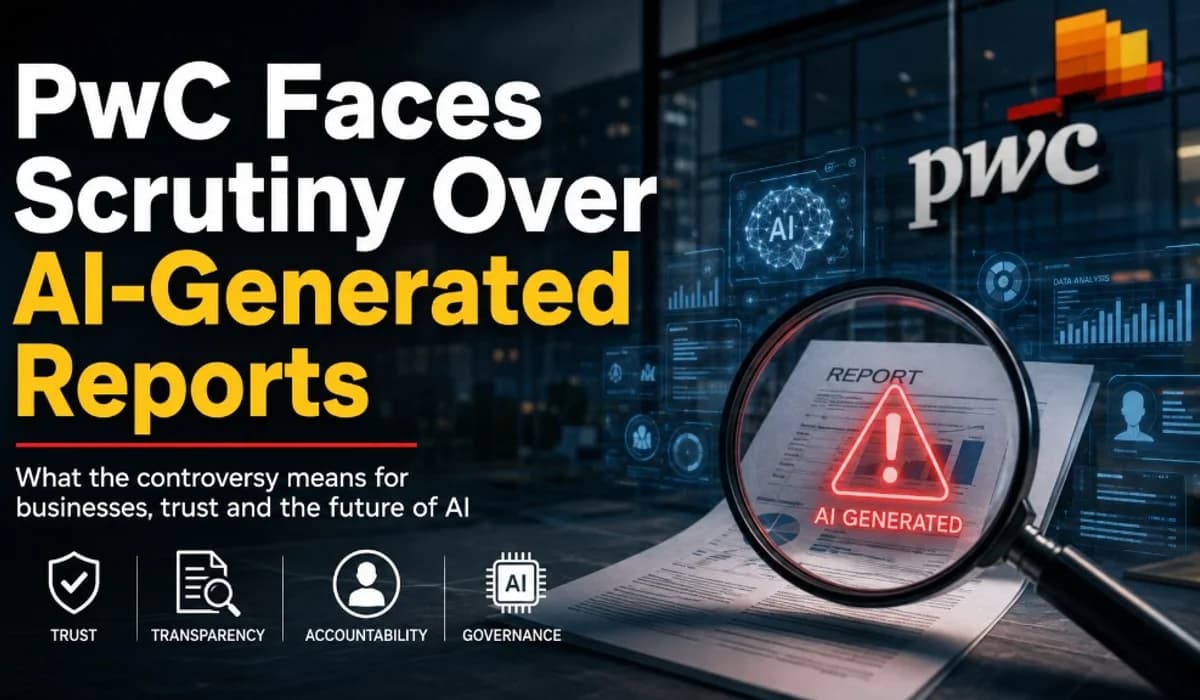
Artificial intelligence was supposed to make professional research faster, smarter and more reliable. But a new controversy involving PwC is exposing the uncomfortable gap between using AI as a productivity tool and using it without enough human verification.
PwC, one of the world's largest accounting and consulting firms, is facing scrutiny after researchers identified fabricated citations, questionable claims and other apparent AI-generated errors in several thought-leadership reports published by its Middle East business. The investigation, conducted by AI-detection company GPTZero and subsequently verified by the Financial Times, examined four reports published between 2024 and 2026.
The story is bigger than one consulting firm's embarrassing citation problem.
The more important question is this: If companies that advise governments and global corporations on responsible AI cannot reliably verify AI-assisted research, what does that mean for everyone else using the same technology?
That is the real lesson behind the growing Pwc Faces Scrutiny Ai Generated story.
Quick steps
- Identify which AI-generated outputs can affect customers, investors, regulators or the public.
- Require primary-source verification for important claims — existence, attribution, currency and link validity.
- Preserve a record of where AI was used in the workflow.
- Establish human sign-off for high-risk material (regulatory, financial, medical, legal or public research).
- Measure the quality of AI-assisted work — not simply the amount of content produced.
What Happened at PwC?
The controversy centers on four PwC Middle East thought-leadership reports covering subjects including artificial intelligence, autonomous or “agentic” AI, government services and electric-vehicle adoption.
Researchers found examples of citations that did not support the statements they accompanied, references that could not be independently verified, misattributed claims and other signs associated with AI hallucination. One report, Transforming Governance, was assessed by GPTZero as having an 84% probability of being entirely AI-generated, with the probability reaching 100% when its reference section was excluded.
That distinction matters.
An AI-generated sentence is not automatically wrong. Generative AI can produce useful drafts, summaries and research assistance. The problem begins when generated material is presented as authoritative research without sufficient human checking.
In professional consulting, citations are not decoration. They are part of the evidence chain supporting an argument.
If a cited paper does not exist, a URL leads nowhere, or a source is incorrectly attributed, the credibility of the entire analysis can be weakened.
PwC has said it takes the matter seriously and has been addressing incorrect citations, although public reporting has raised questions about how such material passed through its quality-control processes.
The Bigger Issue Is Not AI — It Is Verification
It would be easy to describe this as another example of AI “hallucinating.”
That explanation is incomplete.
Large language models are designed to generate plausible language, not to guarantee that every statement or reference is true. When asked for supporting sources, an AI system can sometimes produce references that look convincing but do not actually exist or do not substantiate the claim.
That is a known technical limitation.
The more significant failure is therefore organizational.
A consultant can use AI to brainstorm. A researcher can use it to organize notes. An analyst can use it to identify patterns across thousands of documents. But before the final publication reaches clients, regulators, investors or the public, someone needs to establish answers to basic accountability questions.
The PwC episode shows that AI governance cannot stop at policies saying employees should “use AI responsibly.” Organizations need measurable verification procedures around the output.
- Does the source actually exist?
- Does it say what the report claims?
- Is the statistic current?
- Is the person correctly identified?
- Does the link work?
- Was the underlying data interpreted correctly?
- Can another researcher reproduce the conclusion?
Why This Is Especially Awkward for a Big Four Firm
The controversy is particularly damaging because PwC does not simply sell software or marketing content.
Its business depends heavily on trust, expertise, evidence and professional judgment.
PwC itself has been actively publishing research about AI governance and responsible AI. Its US business, for example, has recently published material arguing that organizations need guardrails, stress testing, AI-native defenses and clear human accountability as AI systems become more autonomous.
That creates an obvious tension.
A company can simultaneously be an important adviser on responsible AI and still experience weaknesses in its own AI-assisted publishing process. The two facts are not necessarily contradictory, but the gap becomes highly visible when the subject of the firm's own research is AI.
This is why the incident matters beyond a handful of reports.
Professional-services companies are increasingly selling confidence about AI while also experimenting with AI internally.
The credibility test is whether their internal controls are as sophisticated as the advice they give clients.
PwC Is Not Alone
The controversy also needs to be viewed against a broader pattern.
PwC is the latest of the Big Four professional-services firms to face scrutiny related to AI-generated errors in research or published material. Researchers have previously examined material associated with Deloitte, EY and KPMG, making the issue look less like an isolated mistake and more like an emerging industry challenge.
That changes the interpretation of the story.
If one employee makes a bad AI-assisted edit, it can be treated as an individual quality-control failure.
If similar problems appear across major consulting organizations, companies may need to rethink how knowledge work is produced in the age of generative AI.
The economics explain part of the pressure.
Consulting firms publish enormous amounts of thought leadership. Producing research requires analysts, writers, subject-matter experts, editors, designers and reviewers. Generative AI can dramatically reduce the time needed to create a first draft.
But reducing production time does not necessarily reduce the amount of work required to validate the final product.
That is the critical distinction many organizations are still learning.
The New Cost of AI: Verification
For years, businesses thought about AI primarily in terms of savings.
If an employee could complete a task in two hours instead of six, AI appeared to create an obvious productivity gain.
But generative AI introduces another cost: verification.
Suppose an AI system creates a 30-page market report in minutes. A human expert may still need hours—or days—to verify its sources, calculations, quotations, market assumptions and conclusions.
In some industries, verification may actually become more expensive because AI can generate convincing mistakes at enormous scale.
That creates a paradox:
AI can make creating information cheaper while making trustworthy information more valuable.
This may become one of the most important business lessons of 2026.
Companies that simply measure how much content employees produce with AI could be measuring the wrong thing. The better metric is how much reliable work they produce.
What This Means for Indian Businesses
The PwC controversy is particularly relevant to companies in India, where generative AI adoption is accelerating across IT services, finance, education, marketing and professional services.
Indian companies do not need to be publishing global consulting reports to encounter the same problem.
Consider a small business using an AI tool to prepare a compliance summary. Or a marketing agency using AI to produce an industry report. Or a startup using a chatbot to prepare investor research.
If nobody checks the references, a polished-looking document can contain errors that are difficult to spot.
The risk becomes greater when AI-generated information is passed from one system to another.
A fabricated statistic can enter a blog post, get repeated on social media, appear in another AI-generated summary and eventually look legitimate simply because it has been repeated several times.
This creates what could be called a trust-compounding problem.
The more frequently an incorrect claim is reproduced, the harder it can become for an ordinary reader to identify its original mistake.
Why AI Detectors Are Not the Final Answer
There is another important lesson here.
The investigation into PwC involved GPTZero, an AI-detection company. Its analysis helped identify suspicious patterns in the reports. But organizations should not interpret this as proof that an AI detector can solve the problem of AI-generated misinformation.
AI detection and fact-checking are different tasks.
A detector may estimate whether text resembles AI-generated writing. That does not establish whether the information is true.
Conversely, human-written material can contain false information.
The stronger approach is therefore source verification rather than simply AI detection.
For a professional report, an organization should be able to trace important claims back to primary documents, datasets, official statistics, peer-reviewed research or directly verified interviews.
That is much harder to automate—and much more valuable.
The Rise of “AI-Assisted” Should Change Editorial Standards
The phrase “AI-assisted” is likely to become increasingly important in professional publishing.
Using AI to correct grammar is fundamentally different from asking AI to create an entire market analysis.
Using AI to summarize a document is different from allowing it to invent supporting references.
Using AI to generate interview questions is different from allowing it to manufacture quotations.
Organizations therefore need risk-based AI policies rather than a single rule covering every use case.
A useful framework could divide AI tasks into three levels.
- Low-risk AI use — grammar correction, formatting, brainstorming and summarization of verified material.
- Medium-risk AI use — research assistance, data interpretation and drafting where a qualified employee checks the output.
- High-risk AI use — regulatory advice, financial analysis, medical information, legal conclusions or public-facing research where unsupported AI output could cause significant harm. The higher the risk, the stronger the human verification requirement should be.
The Most Important Takeaway for Readers
The PwC story should not lead businesses to conclude that AI is useless.
Quite the opposite.
The technology remains extremely powerful. PwC's own 2026 research argues that companies capturing the largest economic gains from AI are going beyond simple productivity improvements and redesigning workflows around the technology. Its study of 1,217 senior executives found that leading companies were more likely to redesign workflows and pursue growth opportunities using AI.
The lesson is that AI adoption and AI governance must advance together.
Organizations cannot treat AI as an intern who needs occasional supervision. Nor should they treat it as an infallible expert.
The best model is closer to a highly capable assistant whose work must be checked according to the consequences of being wrong.
What Businesses Should Do Next
For companies already using generative AI, the practical response is straightforward.
First, identify which AI-generated outputs can affect customers, investors, regulators or the public.
Second, require primary-source verification for important claims.
Third, preserve a record of where AI was used in the workflow.
Fourth, establish human sign-off for high-risk material.
Finally, measure the quality of AI-assisted work—not simply the amount of content produced.
This is particularly important for consulting firms, law firms, financial institutions, healthcare companies and government contractors, where a convincing error can have consequences far beyond a bad blog post.
PwC Faces Scrutiny AI Generated: Why This Story Matters
The current Pwc Faces Scrutiny Ai Generated controversy is not ultimately a story about whether PwC used artificial intelligence.
It is a story about whether organizations can maintain professional standards while dramatically increasing the speed at which information is produced.
That is a much bigger question.
Generative AI has made the production of polished text almost effortless. The scarce resource is increasingly not writing ability, but verified knowledge.
For readers, clients and businesses, the safest response is therefore not to reject AI-generated material automatically. Instead, learn to ask better questions: Where did this claim come from? Can I verify it? Does the source actually support the statement? Who is accountable if it is wrong?
Those questions may become the most valuable form of AI literacy in the years ahead.
The PwC episode is a warning that the future of professional research will not be decided by who can generate the most content the fastest. It will be decided by who can combine AI's speed with human judgment, transparent sourcing and rigorous verification.
Frequently asked questions
Researchers at GPTZero, later verified by the Financial Times, found fabricated or unverifiable citations and other apparent AI-generated errors in four PwC Middle East thought-leadership reports published between 2024 and 2026.
Transforming Governance was assessed by GPTZero at an 84% probability of being entirely AI-generated, rising to 100% when its reference section was excluded. An AI-generated sentence is not automatically wrong — the issue is presenting it as authoritative research without enough checking.
Hallucination is a known model limitation. The more significant failure is organizational: missing measurable human verification of sources, statistics, links and conclusions before publication.
PwC’s business depends on trust and evidence, and it also publishes advice on responsible AI. Weaknesses in its own AI-assisted publishing process create a visible gap between advice sold to clients and internal controls.
No. Researchers have previously examined AI-related errors in material associated with Deloitte, EY and KPMG, suggesting an industry-wide knowledge-work challenge rather than a one-off mistake.
Verification. AI can draft a long report in minutes, but experts may still need hours or days to check sources and claims. AI can make creating information cheaper while making trustworthy information more valuable.
Generative AI adoption is accelerating across Indian IT, finance, education, marketing and professional services. Unchecked AI outputs in compliance summaries, industry reports or investor research can spread errors through a trust-compounding cycle.
No. Detectors estimate whether text looks AI-written; they do not prove truth. Source verification against primary documents is stronger than detection alone.
Use risk levels: low (grammar, formatting, brainstorming), medium (drafting checked by a qualified employee), and high (regulatory, financial, medical, legal or public research) with stronger human sign-off as risk rises.
Map high-impact AI outputs, require primary-source checks, record where AI was used, require human sign-off on high-risk material, and measure reliable quality — not content volume.