

AI guide
PM Modi Asks Ministries to Promote Indian Digital Platforms: What the Zoho and Sarvam Push Means
A July 2026 directive ties Viksit Bharat governance to homegrown SaaS, sovereign AI and secure messaging — with Zoho, Sarvam and Arattai held up as examples ministries should champion.
By Pixelandpdf · Updated 23 August 2026 · 10 min read
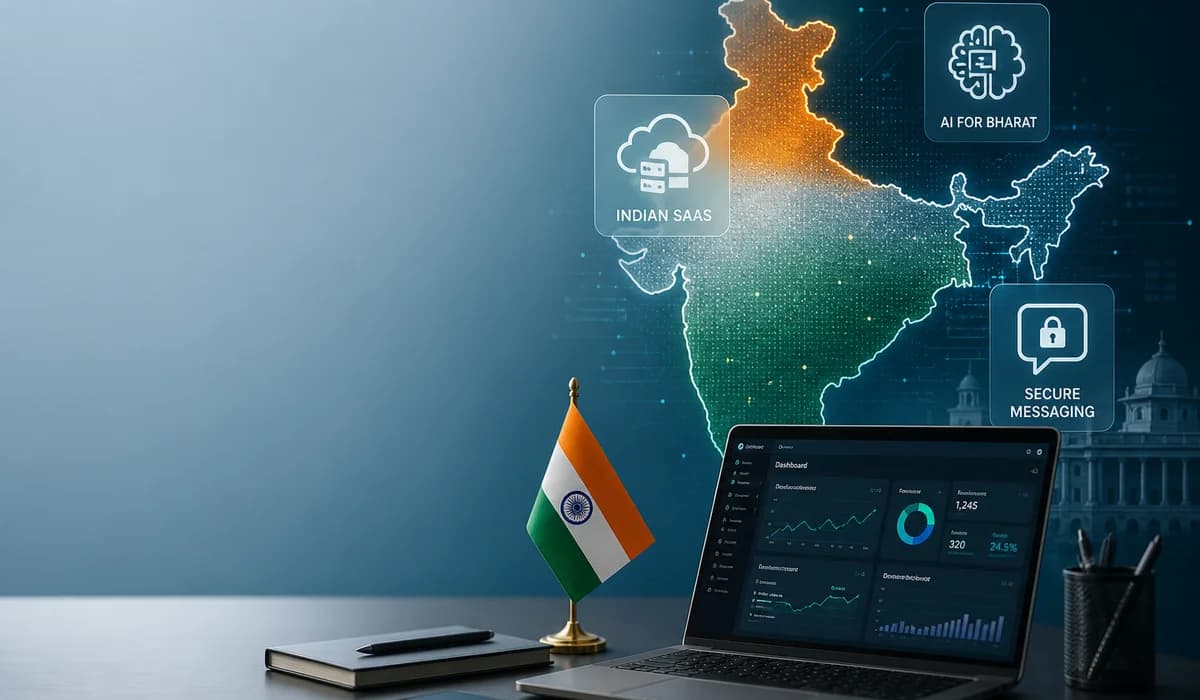
Prime Minister Narendra Modi has asked central ministries and departments to actively promote Indian digital, artificial-intelligence and messaging platforms — explicitly naming Zoho, Sarvam and Arattai as examples worth championing. The instruction arrived as part of a broader 23-point action plan linked to the Viksit Bharat 2047 agenda, with data safety cited as a central reason for favouring domestic tools over foreign defaults.
On the surface, the headline reads like a routine “Buy Indian” nudge. In practice, it sits at the intersection of three much larger stories: how government offices handle sensitive data, whether India can build credible alternatives to global SaaS and AI giants, and how policy signals translate into actual procurement when millions of civil servants still rely on familiar foreign software every day.
If you run a startup, a district office, or a small business that sells into the public sector, the directive matters less as a product endorsement and more as a map of where public money, compliance attention and political capital are likely to flow over the next few years.
Quick steps
- Read the July 2026 Cabinet Secretary letter as a direction to evaluate Indian SaaS, AI and messaging — not an instant ban on foreign tools.
- Map your department’s data flows: email, chat, documents and AI assistants — note where records leave Indian jurisdiction.
- Pilot Zoho-class productivity, Sarvam-class AI or Arattai-class messaging only after security review, not because of naming alone.
- Compare total cost: licences, migration, training, integration and exit risk — cheaper list price is not always cheaper operationally.
- Document procurement decisions transparently; past endorsements (including failed ones) show reputational risk when politics outruns product fit.
What Did PM Modi Ask Ministries to Do?
According to reporting on the July 2026 secretaries’ meeting and the follow-up letter from Cabinet Secretary T V Somanathan, Prime Minister Modi directed ministries and departments to encourage the use of domestic digital, AI and messaging platforms “to ensure safety of our data.” The letter lists 23 action points drawn from the interaction; one of those points specifically mentions platforms such as Zoho, Sarvam and Arattai.
Modi had chaired the meeting on 22 July 2026 with secretaries across infrastructure, connectivity, security, external affairs and wider governance themes. On social platform X, he described discussions on effective use of data and AI, deeper university engagement and stronger research-and-innovation pipelines — framing the session as forward-looking rather than purely administrative.
Coverage in outlets including Storyboard18 and NDTV places the digital-platforms instruction inside that wider Viksit Bharat action plan, which also touches youth participation, sports, skill development, agricultural education, irrigation, industry–academia collaboration and in-house government capability building. The digital push is one line in a long list — but it is the line technology markets are watching.
For authoritative context on the full 23-point framing, see NDTV's summary of the Viksit Bharat plan.
The 23-Point Viksit Bharat Action Plan in Context
Viksit Bharat — “Developed India” — is not a single software policy. It is the long-range development narrative the government has tied to 2047, the centenary of independence. The July 2026 secretaries’ meeting translated that narrative into operational homework: departments received concrete action points meant to cascade into budgets, hiring, partnerships and public-facing programmes.
When a 23-point plan mentions Olympic bids, irrigation, youth sports and Indian messaging apps in the same document, the risk is that each item receives unequal follow-through. Historically, high-visibility tech endorsements attract press releases long before they attract migration projects, training manuals or audited security reviews.
That uneven pace is worth remembering. A secretary-level letter creates permission structures — it tells bureaucrats that recommending an Indian alternative will not automatically be treated as a career-risky oddity. It does not, by itself, rewrite enterprise licence agreements, inter-state vendor empanelment lists or the daily habits of field staff who have used the same foreign tools for a decade.
Moneycontrol and other business outlets reported the roadmap alongside other headline goals, including India's interest in hosting the 2036 Olympics — see Moneycontrol's coverage of the 23-point plan. The digital-platforms bullet is comparatively narrow, but it aligns with a multi-year pattern: treat technology choice as sovereignty choice.
Why Zoho, Sarvam and Arattai Were Named
The government did not publish a competitive scorecard explaining why these three names surfaced together. Reading the public record, however, each occupies a distinct slot in the “Indian alternative” story.
Zoho is the mature SaaS export champion — CRM, mail, office productivity and a growing collaboration stack built from Chennai and Tenkasi rather than Silicon Valley. Ministries already experimenting with Zoho Mail and Zoho Workplace see a credible replacement narrative for document and email workflows that do not require every file to pass through US-headquartered clouds by default.
Sarvam represents the AI layer. The Bengaluru startup has been visible in India’s sovereign-model conversation since its selection under the IndiaAI Mission to work on a homegrown large language model with emphasis on reasoning, voice and Indian languages. Its partnership with UIDAI on voice-based Aadhaar services — multilingual support, fraud alerts — gives policymakers a concrete “AI that touches citizens at scale” example, not a lab demo.
Arattai is Zoho’s messaging play: an Indian-hosted chat alternative positioned against WhatsApp-class networks that dominate civil society and government informal communication. Ministers publicly switching to Arattai in 2025 turned a product launch into a political signal.
Storyboard18's reporting on the July directive is a useful primary news reference.
What Is Digital Sovereignty — and Why Governments Care
Digital sovereignty is the idea that a country should control — or at least clearly govern — where critical data lives, who can access it under what legal process, and which vendors sit in the chain when citizens interact with the state.
India’s push is not unique. The European Union’s GDPR framing, China’s long-standing platform localisation, and US cloud export controls all reflect the same underlying anxiety: modern administration runs on software stacks designed elsewhere, often subject to elsewhere’s courts.
For Indian ministries, the practical triggers are familiar: cross-border discovery requests, vendor terms that permit model training on customer content, outage cascades when a single foreign provider fails, and the reputational damage when citizen data leaks through misconfigured SaaS tenants.
Scroll.in's digital-sovereignty analysis and other outlets have documented earlier chapters of this debate — including NIC email migration discussions and ministerial endorsements of Zoho — under the heading of digital sovereignty. That coverage highlights a tension the July 2026 letter does not resolve: sovereignty is a system property, not a logo swap.
Switching a minister’s email address is symbolic. Migrating procurement, backups, identity federation, mobile device management and decade-old archives is engineering — often boring, always expensive.
Sarvam and the IndiaAI Mission: India’s Sovereign AI Bet
Naming Sarvam alongside Zoho signals that the government’s “Buy Indian” frame now explicitly includes foundation models and voice AI, not only spreadsheets and chat apps.
IndiaAI — the national mission at indiaai.gov.in — has been allocating compute, datasets and institutional partnerships to reduce dependence on a handful of US and Chinese model providers. Sarvam's sovereign LLM track fits a policy story India has told repeatedly since 2024–25: citizen services in Hindi, Tamil, Bengali and dozens of other languages; voice-first interfaces for populations that type slowly on phones; fraud detection that understands local scam patterns.
UIDAI’s generative-AI experiments with Sarvam illustrate why bureaucrats might mention the company by name. Aadhaar is among the largest identity programmes on earth. Any assistant that reads aloud balance updates, warns about suspicious enrolment activity or answers FAQs in regional languages must be auditable, deployable on controlled infrastructure and politically defensible if it hallucinates.
That is a higher bar than “install ChatGPT for the office.” For teams evaluating AI vendors, our guide on how companies train employees on AI covers the gap between handing staff a chatbot and building verification habits — exactly the gap government departments will face if Sarvam-class tools spread faster than governance training.
Developers comparing inference economics for Indian-language agents can also rough-token budgets with PixelAndPDF's free AI token calculator — useful when pilot proposals must show rupee-per-query estimates to finance controllers.
Zoho, Arattai and the Swadeshi Software Push
Zoho’s government moment did not begin in July 2026. In October 2025, the education ministry circulated guidance encouraging officials to use Zoho Suite, describing indigenous productivity tools as aligned with a Swadeshi technology ecosystem. Union ministers — including figures responsible for home affairs and information technology — publicly praised Zoho products and Arattai.
Earlier reporting noted large-scale NIC email contexts involving on the order of twelve lakh government addresses, and ministerial statements about moving party or official communication to Zoho-hosted mail. IT Minister Ashwini Vaishnaw and senior bureaucrats framed the choice as capability plus patriotism: Indian engineering quality good enough for daily ministerial work.
Critics quoted in Scroll.in's digital-sovereignty piece raise a fair process question: should the executive name individual companies, or should empanelment routes and open tenders pick winners? Naming Zoho gives marketing oxygen; it also invites accusations of favouritism if competitors with stronger security certifications lose deals without transparent scoring.
Arattai adds social complexity. WhatsApp is not just consumer chat in India — it is district disaster coordination, vendor negotiation and informal grievance redress. Displacing it requires network effects, not a circular. Koo’s rise and 2024 shutdown remain the cautionary tale: political endorsement without retention mechanics buys headlines, not daily active users.
For offices still exchanging scanned circulars and signed PDFs, local compression before upload remains a mundane but real workflow — see our compress PDF to 200 KB tool — regardless of which cloud suite eventually stores the file.
What This Means for Startups, SMEs and Government Offices
If you sell into government, treat the July directive as a demand signal, not a purchase order. Departments will ask more often: “Is there an Indian option?” Empanelment lists, GeM catalogues and state IT policies may gradually weight domestic hosting, data localisation attestations and Indian-incorporated entities more heavily in scoring matrices.
Small and medium enterprises outside the public sector should watch second-order effects. When large ministries standardise on a domestic stack, training ecosystems, systems integrators and compliance consultants reorganise around those vendors. Zoho partners, Sarvam systems integrators and Arattai deployment shops may see inbound interest even from private firms that want to stay ahead of procurement norms.
For civil servants, the immediate question is practical: does your department have a migration budget, a data classification policy and a help desk that can survive the first month of password resets? Policy letters rarely include those line items.
Universities — explicitly mentioned in Modi’s post-meeting social post — may see funded partnerships tying research grants to industry problems Indian platforms face: Indic speech recognition, low-bandwidth sync, offline-first document editing, court-admissible audit logs.
Businesses navigating AI governance in regulated sectors may find parallels in our artificial intelligence finance guide, which explains how AI moves from assistant to decision infrastructure — the same shift ministries will encounter when Sarvam-class tools leave the demo room and enter case-management workflows.
Risks, Criticism and Lessons from Past Endorsements
Three risks dominate informed criticism of named-platform policies.
First, security theatre. Replacing a foreign SaaS giant with a domestic one does not automatically improve security if administrators disable multi-factor authentication, reuse passwords or grant vendor support broad super-user access. Sovereignty marketing must not substitute for CIS benchmarks, red-team exercises and incident drills.
Second, vendor concentration. Directing dozens of ministries toward the same handful of Indian champions could recreate single-vendor dependency — just with a different headquarters address. Healthy markets need credible second sources, interoperable export formats and exit plans.
Third, politicised product lifecycles. Koo demonstrated that viral ministerial tweets do not sustain a social network. If Arattai or any successor receives push without product-market fit, civil servants may maintain shadow WhatsApp groups anyway, defeating the data-localisation goal.
Former IT secretary commentary reported in business media emphasised a wider push for Indian products rather than singling out one firm — an attempt to square ministerial enthusiasm with procurement fairness norms. That tension will persist.
International partners watching India’s digital sovereignty push may negotiate data-localisation chapters in trade talks, affecting cloud regions, encryption standards and cross-border research collaborations. Domestic platforms gain opportunity; compliance costs rise for everyone.
What Happens Next
Expect a phased rhythm rather than a big-bang switch.
Short term (late 2026): more circulars referencing Indian platforms on GeM, pilot MOUs between ministries and named vendors, conference keynotes tying Viksit Bharat milestones to tech self-reliance. Press releases will outnumber migrations.
Medium term (2027–2028): empanelment refreshes, security audit templates tuned for Indian SaaS, standard operating procedures for AI assistants in citizen-facing call centres, possible budget lines for training contractors. Sarvam’s sovereign-model deliverables under IndiaAI will face public scrutiny if slippage occurs.
Long term (toward 2047): success looks like diversified Indian stacks — not one winner per category — embedded in state and central workflows with documented interoperability. Failure looks like symbolic ministerial accounts on unused apps while operational data still flows through foreign clouds because nobody funded the hard migration work.
Watch three metrics: audited migration completion rates, median incident response times compared with incumbent vendors, and employee satisfaction surveys after 90-day pilots. Benchmarks beat slogans.
Conclusion
PM Modi’s instruction for ministries to promote Indian digital platforms — with Zoho, Sarvam and Arattai held up as examples — is best understood as a sovereignty and data-governance signal inside a wider Viksit Bharat action plan. It tells the bureaucracy that homegrown SaaS, sovereign AI and domestic messaging are politically preferred tools for handling government information.
It does not, by itself, answer the harder questions: which products pass security review, who pays for migration, how inter-agency collaboration works when different departments pick different Indian stacks, and how India avoids repeating endorsement-driven missteps from earlier social platforms.
For founders, the opportunity is real but not guaranteed. For officials, the letter creates air cover to pilot Indian alternatives. For citizens, the payoff arrives only if “data safety” translates into measurable privacy outcomes — not merely into different corporate logos on the login screen.
The next chapter belongs to procurement officers, CISOs and product teams who must turn a 23-point plan into working systems. The headline names are Zoho, Sarvam and Arattai. The underlying story is whether India can make that list longer — and competitive — without naming every future winner in advance.
Frequently asked questions
Reporting on the July 2026 secretaries’ meeting says Modi directed ministries to encourage domestic digital, AI and messaging platforms to protect government data. A Cabinet Secretary letter lists 23 action points, including promotion of platforms such as Zoho, Sarvam and Arattai.
Public coverage does not cite a scored tender, but each maps to a category: Zoho for SaaS productivity and mail, Sarvam for sovereign AI and voice services (including UIDAI-related work), and Arattai for Indian-hosted messaging pitched as a WhatsApp-class alternative.
It is a set of departmental action points emerging from PM Modi’s July 2026 meeting with government secretaries, linked to the Viksit Bharat 2047 development agenda. Topics include infrastructure, governance, youth, agriculture, research — and promoting Indian digital platforms.
Sarvam has been associated with the IndiaAI Mission’s sovereign large language model work and partnered with UIDAI on voice-based Aadhaar services. Naming it reflects policy interest in homegrown AI, not only office software.
The reported directive emphasises encouraging Indian platforms and data safety. It is a policy steer toward domestic options; widespread replacement would still require procurement rules, budgets, security reviews and migration projects.
It refers to controlling where government and citizen data resides, which vendors process it, and which legal regimes apply. Recent pushes include indigenous email, productivity suites, messaging and AI rather than default foreign clouds.
Modi chaired the meeting on 22 July 2026. Cabinet Secretary T V Somanathan’s follow-up letter dated 29 July 2026 circulated the 23 action points to ministries.
Arattai is Zoho’s messaging app, promoted as an Indian alternative for chat. Ministers publicly adopted it in 2025, aligning with Swadeshi tech narratives — though network effects remain a major adoption hurdle.
Koo received strong political endorsement as an Indian Twitter alternative but shut down in 2024. It shows that visibility from ministers does not substitute for long-term retention, moderation capacity and sustainable business models.
Track GeM and empanelment updates, document data-localisation and security posture, pilot integrations with named Indian stacks where clients require them, and budget for training — policy preference does not remove the need for due diligence.